
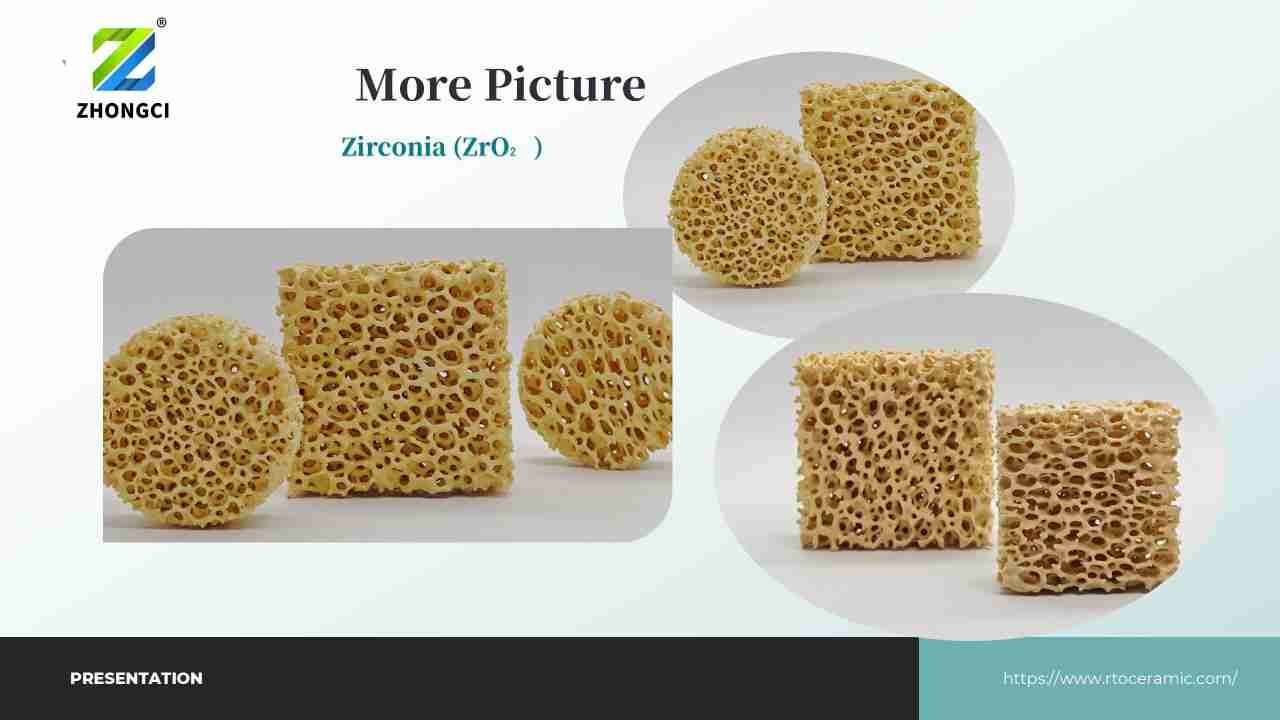
Zirconia foam ceramic filters is a porous filtering material made from zirconia (ZrO₂) . It features high temperature resistance, strong chemical stability, and high filtration efficiency. It used in metallurgy, casting, chemical engineering, and other fields. Here is a detailed introduction from the aspects of structure, performance, applications, and advantages:

I. Basic Structure and Preparation
- Structural Characteristics:
It has a three-dimensional network porous structure with high porosity (usually 70%-90%) and uniform pore size distribution (generally 10-1000μm). This structure is similar to a sponge, allowing fluids (such as molten metals, high-temperature gases) to pass through smoothly while intercepting impurity particles through the pores. - Preparation Process:
Usually, organic foam (such as polyurethane foam) is used as a template. Zirconia slurry is evenly coated on the template skeleton. And after drying and high-temperature sintering, the organic template is burned off, finally forming a zirconia ceramic skeleton similar to the template structure.
II. Core Performance Advantages
- High Temperature Resistance:
Zirconia has a high melting point of 2715°C and good chemical stability at high temperatures. It can withstand the high-temperature (usually 600-1700°C) erosion of molten metals without softening . Or decomposing due to high temperatures. - Chemical Inertness:
It is not easy to react with molten metals, acids, alkalis, and other corrosive media, avoiding contamination of the filtered materials. It is especially suitable for precision casting fields with high purity requirements. - High Strength and Wear Resistance:
The ceramic skeleton has high mechanical strength. It can withstand the impact and pressure of melt flow, and has good wear resistance, resulting in a long service life. - Efficient Filtration Capacity:
The porous structure can effectively intercept inclusions. In molten metals, reduce defects such as pores and inclusions in castings, and improve the mechanical properties and reliability of products.
III. Main Application Fields
- Metal Casting Industry:
It is the most important application field, used for filtering molten metals such as aluminum alloys, copper alloys, magnesium alloys, cast iron, and cast steel. For example:
- In the casting of auto parts (such as engine blocks, wheel hubs), filtering impurities can reduce the rejection rate of castings;
- In precision castings in the aerospace field, filtration improves material purity and ensures component safety.
- High-Temperature Gas Filtration:
It can be used for filtering high-temperature flue gas generated by industrial furnaces, waste incineration, etc., to remove dust particles and reduce pollutant emissions. - Chemical Industry and Environmental Protection:
It is used as a filtering medium in corrosive environments, such as treating high-temperature corrosive liquids or gases to separate solid impurities.
IV. Comparison with Other Filter Materials
| Material Type | Advantages | Limitations | Applicable Scenarios |
|---|---|---|---|
| Zirconia foam ceramic | High temperature resistance, chemical stability, high filtration efficiency | Higher cost, relatively high brittleness | High-temperature molten metals, corrosive environments |
| Alumina foam ceramic | Lower cost, moderate strength | Lower temperature resistance than zirconia (about 1600°C) | Medium and low-temperature metal casting (e.g., aluminum alloys) |
| Silicon carbide foam ceramic | Good thermal conductivity, excellent wear resistance | Slightly poor thermal shock resistance | High-temperature gas filtration, abrasive industry |
The advantages of zirconia foam ceramics in temperature resistance and chemical stability make them the first choice for high-demand scenarios.
V. Usage Notes
- During installation, it should be tightly matched with the runner to prevent molten metal from leaking through the gap, which affects the filtering effect;
- Avoid severe impact or collision to prevent the ceramic sheet from breaking;
- Select filter sheets with appropriate pore sizes according to the type of melt and impurity content (e.g., large pore sizes for rough filtration, small pore sizes for precision filtration).
In conclusion, zirconia foam ceramic filters, with their excellent performance, play a key role in industrial production in improving product quality and reducing defect rates. And are important materials for high-temperature and high-purity filtration scenarios.https://www.chempackings.com/ceramic-foam-filter/sic-ceramic-foam-filter-for-metal-filtration.html