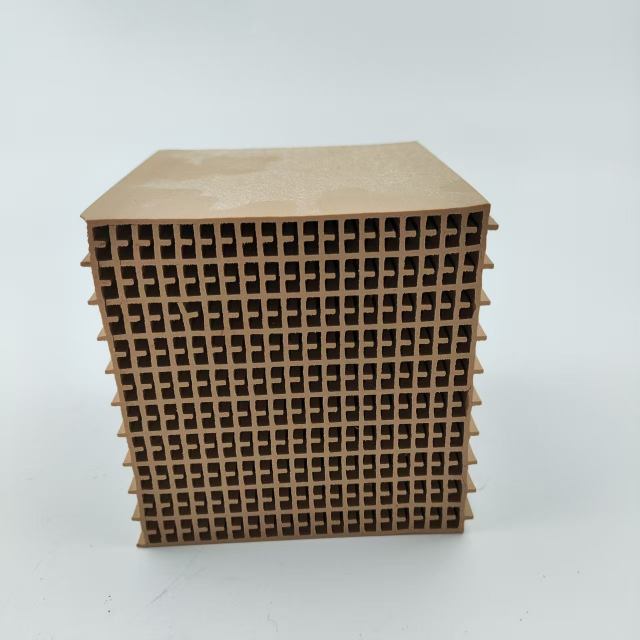
Monolithic Honeycomb Ceramic VS Plate-type RTO

Table of Contents

1. Basic Structural Difference

  • Monolithic Honeycomb Ceramic Extruded and sintered as one single solid block with straight vertical holes, no assembly, no adhesive.
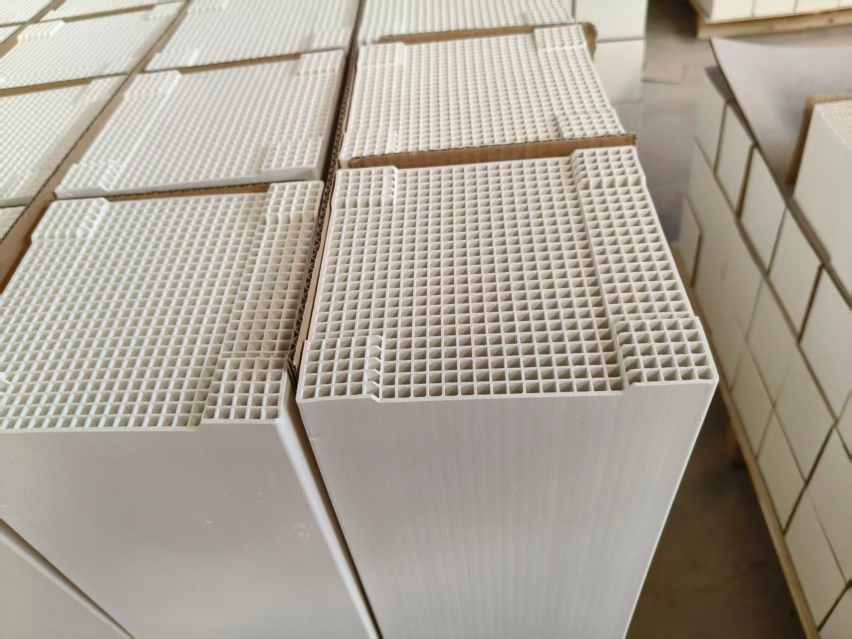
  • Plate-type Honeycomb CeramicMade of many thin ceramic plates stacked & bonded together, forming flow channels between plates, with gaps and adhesive.

2. 4 Key Differences
  1. Pressure Drop (Air Resistance)
    • Monolithic: High resistance (straight holes)
    • Plate-type: Very low resistance (wide channels, turbulent flow)
  2. Anti-clogging Performance
    • Monolithic: Easy to clog (narrow straight holes)
    • Plate-type: High anti-clogging (wide channels, allow bypass flow)
  3. Thermal Shock Resistance
    • Monolithic: Brittle, easy to crack under rapid heating/cooling
    • Plate-type: Excellent thermal shock resistance, not easy to break
  4. Efficiency & Service Life
    • Monolithic: Larger surface area, slightly higher heat exchange efficiency;Lifespan: 5–10 years
    • Plate-type: Slightly lower efficiency but more energy-saving;Lifespan: 3–5 years (adhesive aging)

3. Summary

Monolithic: Higher efficiency, longer lifespan, but easy to clog and high resistance.https://www.rtoceramic.com/product/honeycomb-ceramic-heat-exchanger/

Plate-type: Anti-clogging, low resistance, thermal stable, but shorter life and higher cost.

Monolithic honeycomb ceramic is extruded as a single solid piece with straight, uniform channels. It features larger specific surface area, higher heat exchange efficiency, stronger structural integrity, and longer service life of 5–10 years. However, it has high airflow resistance, poor thermal shock resistance, and is easy to clog with dust or tar.

Plate-type honeycomb ceramic is assembled by stacking thin ceramic sheets. It offers extremely low pressure drop, excellent anti-clogging ability, and outstanding thermal shock stability, making it ideal for dusty, tarry exhaust and RTO systems. Its only drawbacks are slightly lower efficiency, shorter lifespan of 3–5 years due to adhesive aging, and higher cost.

4. Selection Guide

  • Clean exhaust (no dust/tar): Monolithic Honeycomb
  • Dust/tar-containing exhaust: Plate-type Honeycomb
  • RTO, large air flow, energy-saving priority: Plate-type Honeycomb
  • Cost-sensitive, long-term use: Monolithic Honeycombhttps://www.chempackings.com/honeycomb-ceramic/

What is a honeycomb ceramic regenerator and what is its function?

Honeycomb ceramic regenerator is the key and core component of regenerative high-temperature combustion technology (HTAC technology). It has been widely used in various pusher-type heating furnaces, walking-type heating furnaces, heat treatment furnaces, forging furnaces, melting furnaces, ladle/tundish roasters, soaking furnaces, radiant tube burners, and hood-type furnaces in the metallurgical machinery industry. Furnace, blast furnace hot blast stove; various ceramic kilns, various glass kilns in the building materials industry; various tubular heating furnaces, cracking furnaces and other industrial furnaces in the petrochemical industry. Material of honeycomb ceramic regenerator: Regenerator material——mullite, cordierite, cordierite-mullite, corundum-mullite, high-aluminum and other materials honeycomb ceramic regenerator are resistant to With significant advantages such as high temperature, corrosion resistance, good thermal stability, high strength, large heat storage, and good thermal conductivity, the various indicators of the product can fully meet the use and operation requirements of industrial furnaces.

What is honeycomb ceramic regenerator – honeycomb ceramic regenerator hole pattern:

Thermal body hole type——Produces four hole types including square hole, hexagonal hole, round hole, and triangular hole.

Application of honeycomb ceramic regenerator: The principle of the regenerative incineration system (RTO) is to use ceramic regenerators to store the heat generated when organic waste gases are decomposed, and use the thermal energy stored in the ceramic regenerators to decompose untreated organic waste gases. , thereby achieving high thermal efficiency.

In view of the process requirements of the regenerative combustion deodorization oven (RTO), honeycomb ceramic products of various materials and sizes such as dense cordierite, loose cordierite, lithium porcelain, mullite, etc. are developed, which have large specific surface area and excellent exhaust resistance. Small, low thermal expansion and contraction coefficient, high bulk density, good thermal shock resistance and other characteristics.

This product is widely used in waste gas treatment equipment in the chemical industry, automotive paint, spray paint drying equipment, organic chemical industry, petrochemical industry, engraving printing, offset printing, food processing and other industries. For more specifications, please see the product page: Honeycomb Ceramic Regenerator

Share your Needs!

Share

Get Custom Quote

Have a question? Get in touch instantly using the form below.
Our customer support team would get back to you soon.

    Get Custom Quote