
Honeycomb Ceramic RTO, also known as Honeycomb ceramic heat storage RTO & RTO with ceramic honeycomb heat accumulator
1. Start with Cell Density (cpsi) Selection
Cell density directly impacts heat exchange efficiency and pressure drop.
Choose 100-150 cpsi for dusty gas or high airflow speed applications.
These low-density options have wider channels and lower blockage risks.
Opt for 200-300 cpsi for most standard industrial furnace conditions.
They balance heat transfer performance and pressure drop effectively.
Select 350-400+ cpsi for clean natural gas combustion systems.
High-density models deliver superior energy savings with larger surface areas.
Avoid high cpsi if your gas contains significant dust or impurities.
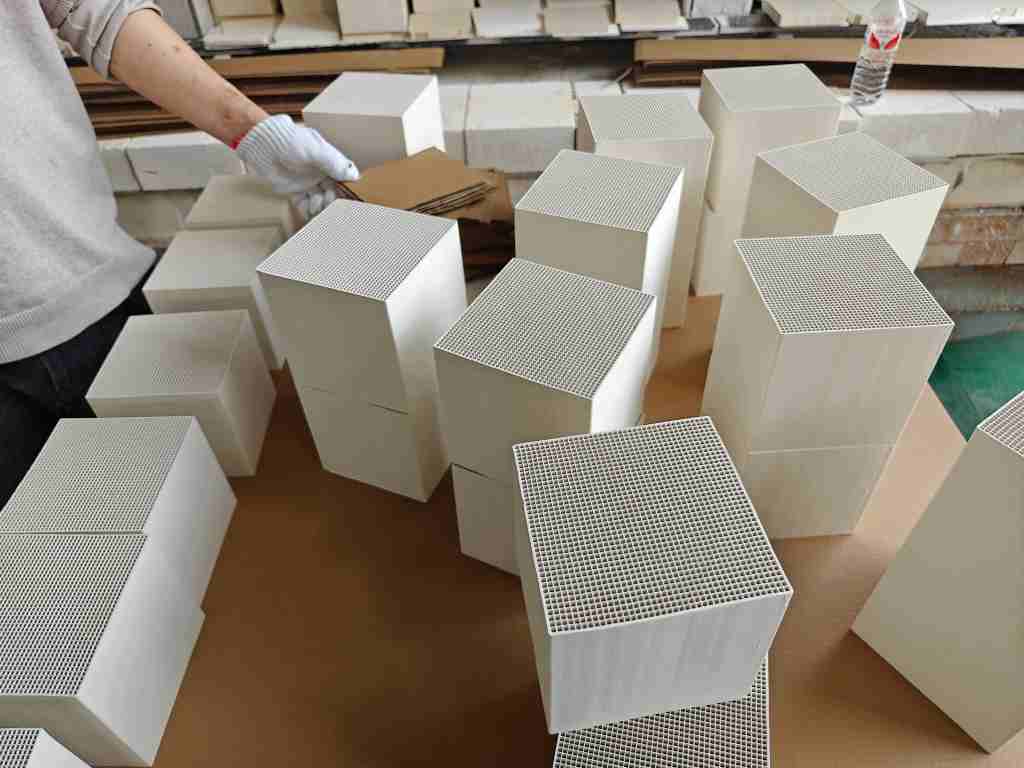
2. Choose the Right Material Based on Temperature
Cordierite works best for temperatures below 1200°C in regular furnaces.https://www.chempackings.com/honeycomb-ceramic/honeycomb-ceramic-heat-exchanger.html
It offers excellent thermal shock resistance with low expansion rates.
Pick mullite for applications between 1300-1400°C.
This material combines good heat resistance and thermal stability.
Select silicon carbide for temperatures above 1500°C or corrosive environments.
It provides top-tier heat conductivity and corrosion resistance.
Consider cost-effectiveness—cordierite suits most common industrial needs.
Prioritize material certifications like ISO 9001 for quality assurance.
3. Match Specifications to Your Working Conditions
Check thermal shock resistance (≥300°C for standard use).
Ensure the regenerator handles rapid temperature switches (30-180 seconds).
Confirm compressive strength meets your system’s pressure requirements.
Customize dimensions to fit your regenerator chamber precisely.
Square, hexagonal, or circular channels suit different airflow demands.
Hexagonal cells often offer better structural stability and flow uniformity.
Request samples for performance testing if your 工况 is unique.
Verify dimensional accuracy to ensure tight installation and even airflow.https://www.rtoceramic.com/product-category/all-products/rto-honeycomb-ceramic/

4. Partner with Reliable Suppliers
Look for suppliers offering technical consultation and after-sales support.
Ask for TDS (Technical Data Sheet) to verify key performance indicators.
Ensure they provide customization for non-standard sizes or shapes.
Check delivery timelines (7-30 working days is industry standard).
Prioritize manufacturers with ISO 14001 and ISO 45001 certifications.
Request on-site installation guidance if needed for complex systems.
Compare heat recovery rates—aim for 90% or higher for energy efficiency.
Avoid suppliers who cannot provide clear performance test results.
Honeycomb Ceramic RTO . By integrating these steps, you select a regenerator that boosts efficiency, reduces costs, and extends system lifespan. Always align choices with your specific temperature, gas composition, and operational demands.