
DOC honeycomb ceramic has become a fundamental component in modern diesel exhaust aftertreatment systems. It supports emission compliance for heavy-duty trucks, construction machinery, diesel generators and industrial diesel equipment. As global emission standards grow stricter year by year, this ceramic substrate plays an irreplaceable role in cleaning diesel exhaust and protecting engine performance.
What Is DOC Honeycomb Ceramic
DOC stands for Diesel Oxidation Catalyst. And Most DOC carriers adopt cordierite honeycomb ceramic as the base material. The product features dense, straight and uniform honeycomb channels on its surface. Manufacturers coat precious metal catalysts on the inner wall of each channel. These structured channels create large contact areas for exhaust gas reaction.https://www.chempackings.com/honeycomb-ceramic/
The DOC unit installs at the front of the entire exhaust treatment system. And It directly processes high-temperature diesel exhaust. It oxidizes harmful carbon monoxide and unburned hydrocarbons into harmless carbon dioxide and water. It also converts part of nitric oxide into nitrogen dioxide. This reaction builds stable working conditions for the downstream DPF particle trap and ensures the whole aftertreatment system runs efficiently.
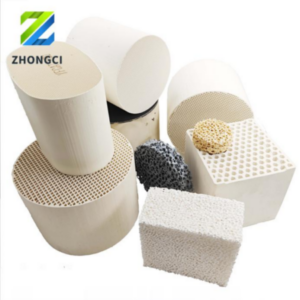
Key Performance Advantages
First, it delivers outstanding thermal stability and thermal shock resistance. And diesel engines generate frequent temperature changes during operation. Cordierite ceramic owns an ultra-low thermal expansion rate. It resists cracking and damage under rapid heating and cooling cycles. It maintains stable performance in the common working temperature range of 200℃ to 650℃.
Second, it keeps low exhaust back pressure. The thin-wall straight-through honeycomb structure allows smooth exhaust flow. It does not block engine exhaust or increase operation resistance. And It avoids common problems such as engine power drop and higher fuel consumption caused by poor substrate design.
Third, it provides sufficient specific surface area. Fine and orderly honeycomb channels offer ample attachment space for catalyst coating. The firm combination of ceramic substrate and precious metals improves catalytic efficiency. It guarantees long-term and stable exhaust purification effects in complex working conditions.
Main Application Scenarios
It widely serves commercial diesel vehicles and engineering machinery. It matches light trucks, heavy trucks, excavators, loaders and stationary diesel generators. And It adapts to Euro 5, Euro 6 and various national standard emission upgrade projects. It works well in both road transportation and non-road engineering equipment fields.
Conclusion
It is not only a simple carrier material, but also the core guarantee of diesel exhaust purification. Its stable structure, reliable performance and low loss characteristics make it a standard choice for mainstream aftertreatment systems. It balances emission reduction effect and engine operating efficiency, and brings long-term value for diesel equipment emission compliance.https://www.rtoceramic.com/products/