
Is the Production Process of Far-Infrared Honeycomb Ceramic Plates Complex?
The production process of far-infrared honeycomb ceramic plates is relatively complex and falls under the category of “precision ceramic manufacturing.” It involves multiple core steps that require strict control, with extremely high requirements for raw material ratios, temperature, and molding accuracy. Even minor deviations in any step can affect the final product’s performance—such as far-infrared radiation efficiency, structural strength, and pore uniformity.
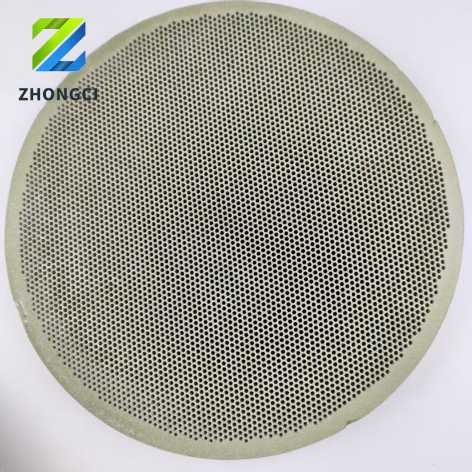
1. Raw Material Preparation: Precision in Ratio and Mixing is Fundamental
This step determines the product’s core performance and marks the starting point of process complexity. It needs to address two critical issues: “uniform dispersion of raw materials” and “compatibility of functional components.”
- Raw Material Screening and Ratio: High-purity basic ceramic materials are selected. Meanwhile, far-infrared radiating agents binders .And pore-forming agents . The ratio error must be controlled within ±0.5%. Otherwise, it directly impacts the structural stability and far-infrared emissivity of the sintered product.
- Wet Mixing and Slurry Preparation: The above raw materials using agate or high-alumina balls as grinding media to avoid contamination to form a uniform slurry. During this process, the slurry’s viscosity and particle size are monitored in real time. Insufficient grinding leads to “impurity agglomeration” on the honeycomb pore walls during subsequent molding. And which easily causes cracking after sintering.
2. Honeycomb Molding: Precise Replication of Complex Structures
Molding the honeycomb structure is a process difficulty. It requires “uniform and unobstructed channels” and “consistent pore wall thickness”. The mainstream method currently used is extrusion molding. And which demands high standards for equipment and molds.
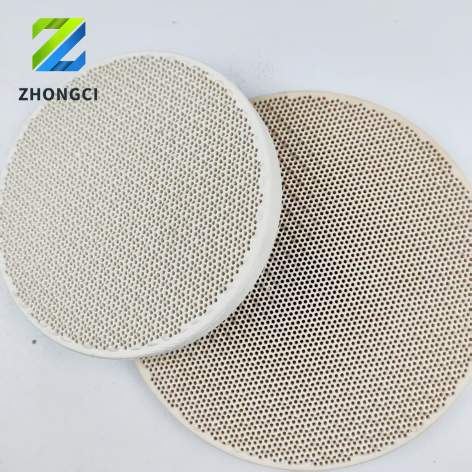
- Mold Design and Manufacturing: Honeycomb molds are precision-machined from high-strength alloys . And it can prevent channel deformation due to uneven resistance when raw materials are extruded. The manufacturing cost of a high-precision honeycomb mold. And it can reach hundreds of thousands of yuan. And its service life is limited (usually requiring repair after producing 10,000-20,000 pieces).
- Extrusion Molding Control: The prepared slurry is fed into a screw extruder and extruded through the mold under constant pressure. And temperature (40-60℃, to maintain binder activity). The extrusion speed (usually 0.5-1 m/min) must be strictly controlled: excessive speed easily causes pore wall breakage. While insufficient speed leads to clay accumulation inside the mold and channel blockage. After extrusion, the wet green body is left to “age” in a constant temperature and humidity environment for 24-48 hours to prevent cracking from rapid moisture loss.
3. Degreasing and Sintering: Structural and Performance Regulation at High Temperatures
This step transforms the “wet green body” into a “ceramic finished product.” It requires precise temperature control to achieve “organic matter removal,” “ceramic grain growth,” . And “far-infrared function activation”—while avoiding structural deformation or cracking. The process window is narrow.
- Degreasing (Binder Removal) Process:
- High-Temperature Sintering Process: https://www.chempackings.com/ceramic-foam-filter/sic-ceramic-foam-filter-for-metal-filtration.html
4. Post-Processing: Performance Testing and Precision Correction
Even after sintering, multiple steps are needed to ensure product compliance, further reflecting process complexity.
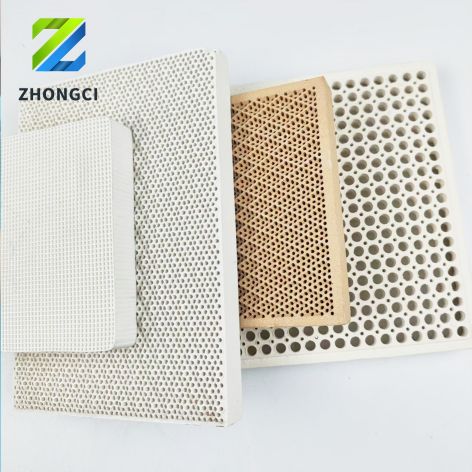
- Performance Testing: Professional equipment is used to test core indicators: far-infrared emissivity (required to be ≥0.85, and ≥0.9 for some high-end products), compressive strength (≥15 MPa), thermal stability (no cracking after repeated heating to 600℃ and cooling), and channel size/connectivity rate (required to be ≥98%, otherwise thermal conduction is affected). Non-compliant products require rework (e.g., surface defect repair) or direct scrapping. The qualification rate in some high-end fields (e.g., industrial catalysis) is only 70%-80%.
- Cutting and Polishing: According to application needs, the sintered ceramic plates are cut into specific sizes (e.g., 300×200 mm for household heaters). Diamond saw blades are used for cutting, and the cutting accuracy must be controlled within ±0.5 mm to avoid edge cracking due to stress concentration. Finally, the surface is polished (roughness Ra ≤1.6 μm) to ensure good fit during installation.
Summary: Core Reasons for Process Complexity
The production process of far-infrared honeycomb ceramic plates is complex essentially due to the dual constraints of “functional requirements” and “structural requirements.” It not only needs precise raw material ratios and sintering control to achieve efficient far-infrared radiation but also requires precision molding and temperature control to ensure the uniformity and stability of the honeycomb structure. Moreover, each step has an extremely small parameter tolerance, and its requirements for equipment precision, operational technology, and quality control are far higher than those of ordinary ceramic products. Therefore, it belongs to the category of “technology-intensive” manufacturing, and currently, the number of domestic enterprises with mature mass production capabilities remains relatively limited.https://www.rtoceramic.com/product/alumina-foam-ceramic-filter-plate-for-aquarium-filter-media/