
1. Industrial Drying and Thermal Processing
- Drying Equipment
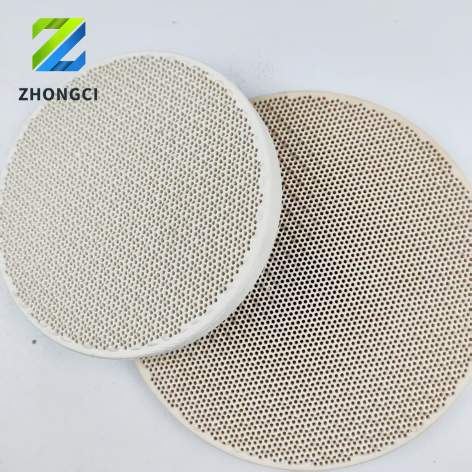
Far-infrared honeycomb ceramics are widely integrated into industrial dryers for textiles, paper, ceramics, and food processing. Their radiation (4–18 μm wavelength) directly penetrates materials, causing internal water molecules to vibrate and evaporate, which reduces drying time by 30–50% compared to convection heating. For example, in ceramic tile production, honeycomb ceramic heaters enable uniform drying of green bodies, minimizing cracking and improving product quality. - Heat Treatment Furnaces
In metal annealing or glass tempering furnaces, these ceramics act as radiant burners, distributing heat evenly across the workspace. Their high thermal stability (withstanding >1,200°C) ensures consistent performance in continuous production lines, while the honeycomb structure reduces heat loss by up to 20%.
2. Environmental Protection and Catalysishttps://www.rtoceramic.com/products/
- Air Pollution Control
As catalyst supports in automotive exhaust systems, honeycomb ceramics (e.g., cordierite-based) provide a large surface area (up to 600 cells per square inch) for noble metal catalysts (Pt, Pd, Rh). The porous channels facilitate efficient contact between exhaust gases and catalysts, converting CO, NOx, and hydrocarbons into CO₂, N₂, and H₂O. Similar applications exist in industrial flue gas purification systems. - Water Treatment
Modified with photocatalytic materials (e.g., TiO₂), far-infrared honeycomb ceramics can degrade organic pollutants in water under light irradiation. The honeycomb structure enhances water flow distribution and maximizes contact with the catalyst, making them suitable for wastewater treatment in printing, dyeing, and pharmaceutical industries.
3. Medical and Health Applications
- Therapeutic Devices
Far-infrared radiation from these ceramics is used in physiotherapy equipment (e.g., heating pads, sauna cabins) to promote blood circulation and cellular metabolism. The 6–14 μm wavelength range is particularly effective for deep tissue heating, relieving muscle pain and supporting recovery from arthritis. Portable devices like far-infrared patches also utilize these ceramics for localized therapy. - Medical Equipment
In sterilization devices, honeycomb ceramics emit far-infrared rays to inactivate bacteria and viruses on medical instruments. Their high-temperature resistance allows repeated use without performance degradation, making them safer than chemical sterilization methods in certain scenarios.
4. Energy Conservation and New Energy
- Household Heating Systems
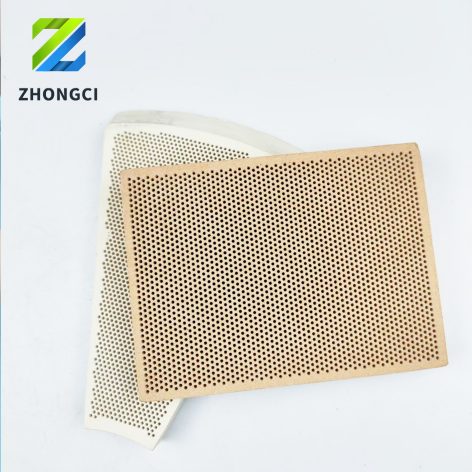
Far-infrared honeycomb ceramic heaters are used in electric fireplaces, floor heating, and space heaters. Unlike traditional resistive heaters, they transfer heat via radiation, reducing energy consumption by 15–30%. The honeycomb structure also enables compact designs, suitable for smart home integration. - Solar Energy Utilization
Combined with photovoltaic materials, these ceramics enhance solar thermal conversion efficiency. For example, in solar water heaters, honeycomb ceramic absorbers coated with selective coatings maximize far-infrared absorption, increasing heat collection by up to 25% in low-light conditions.
5. Agricultural and Horticultural Applications
- Crop Drying and Greenhouse Heating
In post-harvest processing, far-infrared honeycomb ceramic dryers preserve the nutritional value of grains, fruits, and herbs by minimizing thermal damage. In greenhouses, they provide uniform heating to maintain optimal temperatures for plant growth, especially in cold regions. - Livestock Farming
Used as infrared brooders for poultry, these ceramics offer gentle, energy-efficient heating that promotes chick growth while reducing electricity costs. The honeycomb design prevents dust accumulation, ensuring hygienic conditions.
6. Advanced Manufacturing and Electronics
- Semiconductor Processing
In semiconductor manufacturing, far-infrared honeycomb ceramic plates are used in rapid thermal processing (RTP) systems to anneal thin films or activate dopants. The uniform radiation ensures precise temperature control within ±1°C across wafers, critical for nanoscale device fabrication. - Electronic Component Drying
For drying sensitive electronic components (e.g., circuit boards, capacitors), far-infrared radiation avoids thermal stress damage. Honeycomb ceramic heaters enable fast, low-temperature drying (40–80°C), compatible with heat-sensitive materials like polymers and adhesives.
Key Application Case Studies
| Industry | Application Example | Technical Advantage |
|---|---|---|
| Automotive | Three-way catalytic converter | 90%+ pollutant conversion efficiency |
| Food Processing | Infrared rice dryer | 40% faster drying than hot air, maintains taste |
| Medical | Far-infrared physiotherapy bed | Deep tissue penetration, non-invasive heating |
| Renewable Energy | Solar thermal collector | 85% light-to-heat conversion efficiency |
Future Application Trends
- Integration with Smart Systems: Development of IoT-connected far-infrared honeycomb ceramic devices for real-time temperature monitoring and adaptive control.
- Nanocomposite Modification: Coating with nanomaterials (e.g., graphene) to enhance radiation intensity and expand the wavelength range.
- Biomedical Innovations: Use in targeted drug delivery systems, where far-infrared radiation triggers controlled release in specific body regions.
By leveraging their structural and functional versatility, far-infrared honeycomb ceramics continue to drive innovation across diverse industries, addressing challenges in efficiency, sustainability, and precision.https://www.chempackings.com/honeycomb-ceramic/