
Advantages and Disadvantages of Honeycomb Ceramic Regenerators
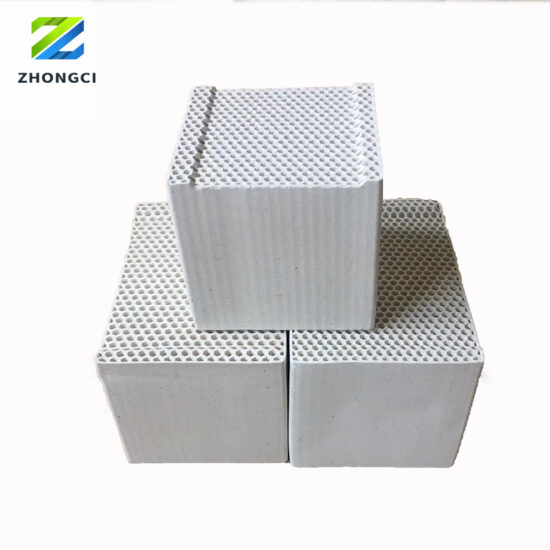
Core Advantages: Performance Benefits from Structure and Materialshttps://www.rtoceramic.com/product-category/all-products/ceramic-foam-filter-plate/
- High Efficiency in Heat Storage and Heat Exchange
- Large specific surface area boosts efficiency: The honeycomb straight-channel structure (specific surface area up to 1000–3000 m²/m³) enables full contact between high-temperature fluids (e.g., flue gas) and the regenerator, facilitating rapid heat transfer. Compared to traditional granular or block regenerators, its heat storage rate is 30–50% higher, and waste heat recovery efficiency can exceed 80% (in industrial furnaces, it can reduce flue gas temperature from over 1000°C to below 200°C).
- Uniform heat transfer: Regular channels stabilize fluid flow, avoiding local overheating or uneven heat distribution, thus reducing energy waste.
- Excellent High-Temperature Resistance and Chemical Stability
- Withstands extreme temperatures: Mainstream materials (e.g., silicon carbide, mullite) tolerate 1000–1600°C, while corundum-based products can even endure over 1800°C, making them suitable for high-temperature scenarios like industrial furnaces and waste incinerators.
- Corrosion and oxidation resistance: Ceramic materials are chemically inert, resisting erosion from acidic gases (e.g., SO₂, HCl) and dust in flue gas. Their service life in corrosive environments (e.g., chemical, metallurgical industries) reaches 3–5 years, surpassing metal regenerators (1–2 years).
- Low Flow Resistance and Flexible Adaptability
- Minimizes fluid resistance: Straight channels reduce flow resistance for gases, consuming 40–60% less energy than granular bed regenerators. This suits continuously operating industrial equipment (e.g., continuous rolling furnaces).
- Customizable specifications: Pore density (100–600 cpsi), size, and materials can be tailored. For example, low pore density (100 cpsi) prevents clogging in dusty flue gas, while high density (400 cpsi) enhances efficiency in clean high-temperature environments.
- Long Lifespan and Low Maintenance Costs
- Good thermal shock resistance: Cordierite-based regenerators tolerate rapid temperature fluctuations (e.g., 800°C to 200°C) without cracking. They require minimal replacement, with maintenance intervals of 1–2 years (far longer than metal regenerators, which need frequent upkeep due to high-temperature oxidation).
Key Disadvantages: Limitations from Materials and Structure
- Poor Impact Resistance, Prone to Cracking
- Brittleness of ceramics: Ceramic materials are inherently brittle, making them susceptible to chipping or cracking during transportation, installation, or exposure to hard particles (e.g., metal debris) in fluids, which can erode channel walls.
- Difficult to repair: Cracked regenerators cannot be repaired and must be replaced entirely, potentially causing downtime (e.g., 1–2 days for replacing modules in large industrial furnaces).
- Low Efficiency in Low-Temperature Heat Storage
- Specific heat capacity constraints: Ceramics perform well at medium-to-high temperatures (>500°C) but have weak heat storage capacity at low temperatures (<300°C) compared to water or phase-change materials. For example, in civilian heating (60–80°C water), their efficiency is only 60–70% of water-based storage, making them economically unviable.
- High Initial Costs
- Material and manufacturing expenses: High-performance ceramics (e.g., silicon carbide) are costly, and honeycomb structures require extrusion molding and high-temperature sintering, increasing production complexity. This makes them 2–3 times more expensive than metal regenerators of the same volume.
- Adaptation costs: Viscous impurities (e.g., tar) in fluids can clog channels, requiring additional filtration systems and raising overall investment.
- Heavy Weight, Requiring Equipment Load-Bearing Design
- High density: Ceramics have a high density (2.5–3.5 g/cm³). Large regenerator modules (e.g., 1m diameter, 2m height) can weigh several tons, demanding strong structural support. Older factories may need foundation reinforcement during retrofits, adding costs.
Summary
Honeycomb ceramic regenerators excel in high-temperature (>500°C), clean or low-impurity fluid, and continuous-operation scenarios (e.g., industrial furnace waste heat recovery, VOCs catalytic combustion). However, they are less suitable for low-temperature applications, fluids with heavy hard particles, or cost-sensitive projects (where metal regenerators or phase-change materials may be better alternatives). Their disadvantages can be mitigated through design optimizations (e.g., wear-resistant coatings), but their core strengths make them irreplaceable in high-temperature industrial settings.https://www.chempackings.com/honeycomb-ceramic/