
I. Key Advantages-Cordierite Honeycomb Ceramic Regenerators
- Exceptional Thermal Shock Resistance-Pros and cons of the Cordierite Honeycomb Ceramic Regenerators
- Cordierite features an extremely low thermal expansion coefficient (1.4–1.7×10⁻⁶/°C), significantly lower than most ceramics (e.g., alumina at ~8×10⁻⁶/°C). This allows it to withstand rapid temperature fluctuations (e.g., from 800°C to room temperature) without cracking, making it ideal for equipment with frequent start-stop cycles or periodic heating, such as regenerative burners and thermal oxidizers.
- Application Example: In regenerative thermal oxidizers (RTOs), cordierite regenerators endure temperature swings during waste gas incineration, extending equipment lifespan.
- Good Thermal Stability and Medium-Temperature Adaptability
- It operates reliably up to 1200°C, suitable for most industrial medium-to-high-temperature scenarios (e.g., waste heat recovery in glass furnaces and industrial boilers). While lower than mullite (1600°C), it suffices for common applications like automotive exhaust treatment and VOCs purification.
- Structural Feature: Its fine-grained structure (grain size typically <5μm) after sintering ensures chemical inertness at medium temperatures, resisting reactions with acidic or alkaline gases.
- Lightweight and High Porosity
- With a density of only 1.0–1.3 g/cm³ (about half of mullite), it reduces equipment load and installation costs.
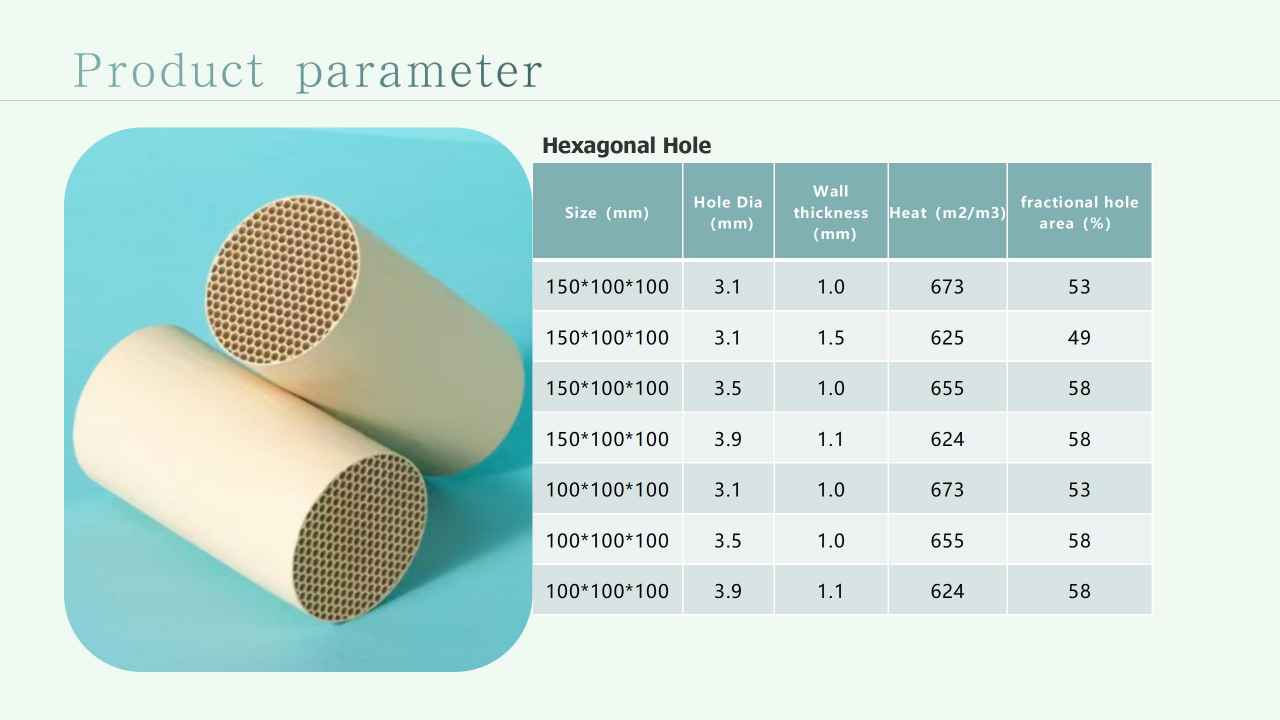
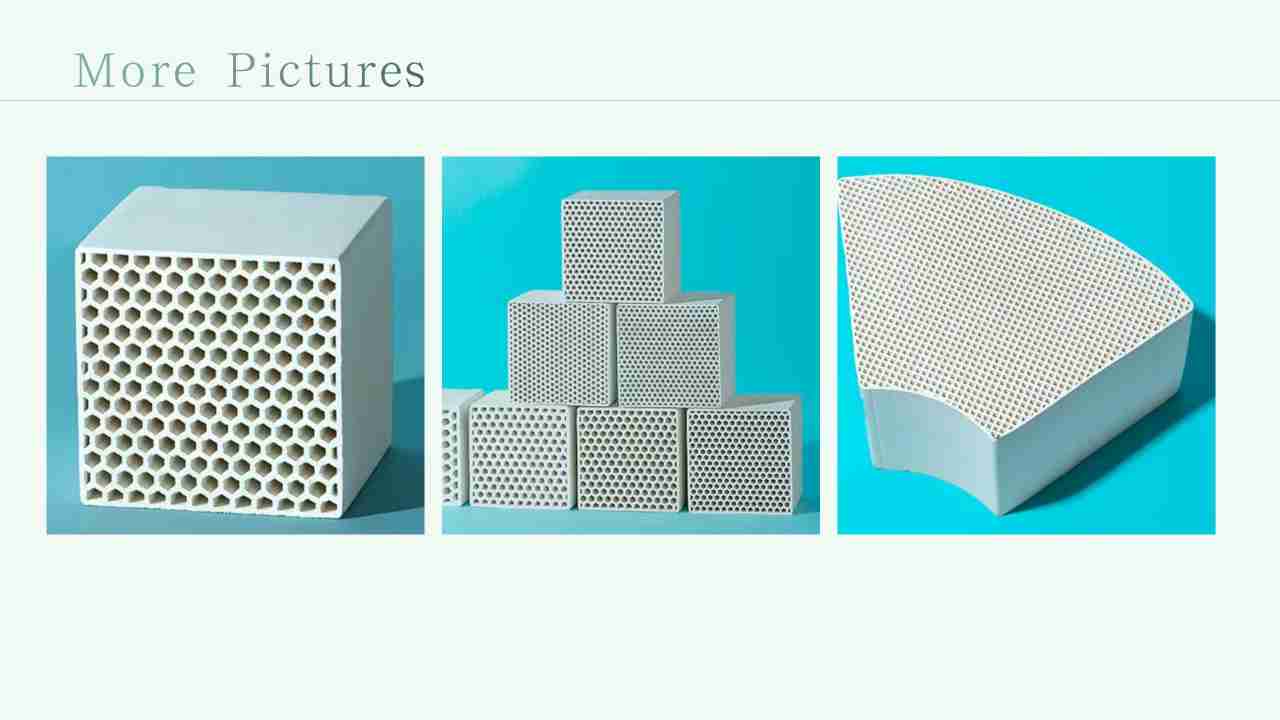
- Its porosity reaches 40%–60%, and honeycomb channels (typically 100–600 CPSI) greatly increase the specific surface area (100–300 m²/m³), enhancing heat exchange efficiency. For instance, in automotive catalytic converters, its lightness reduces exhaust backpressure, improving fuel economy.
- Cost-Effectiveness
- Raw materials (e.g., talc, kaolin, alumina) are widely available, and the sintering temperature (1300–1400°C) is lower than mullite (1600–1700°C), reducing energy consumption and production costs. This suits large-scale industrial applications, such as standardized components for waste gas treatment systems.
II. Major Disadvantages
- Limited High-Temperature Resistance
- Above 1200°C, cordierite undergoes gradual solid-phase reactions, causing lattice structure decomposition and strength degradation. In steel heat treatment furnaces (often exceeding 1400°C), cordierite regenerators may fail due to long-term high-temperature creep, requiring substitution with mullite or corundum materials.
- Moderate Mechanical Strength and Abrasion Resistance
- Its compressive strength is 30–50 MPa, lower than mullite (>80 MPa) and alumina ceramics (>100 MPa). In gas flows with particulates (e.g., flue gas from coal-fired boilers), channel edges are prone to erosion, leading to structural damage.
- Solution: Surface coating (e.g., alumina film) can enhance abrasion resistance but increases costs.
- Inadequate Chemical Corrosion Resistance
- In strongly acidic or alkaline atmospheres (e.g., industrial waste gases with SO₂ or HCl), the MgO in cordierite reacts with corrosive gases to form soluble salts (e.g., MgSO₄), causing material pulverization. For example, chlorine in waste incinerator flue gas may accelerate cordierite degradation.
- Relatively Low Thermal Conductivity
- With a thermal conductivity of 1.0–1.5 W/(m·K) (lower than mullite’s 2.0–3.0 W/(m·K)), it may limit heat release efficiency in scenarios requiring rapid heat conduction (e.g., short-cycle rapid heating/cooling), affecting system response speed.
III. Application Scenario Suitability-Cordierite Honeycomb Ceramic Regenerators
| Advantage-Driven Scenarios | Disadvantage-Restricted Scenarios |
|---|---|
| – Equipment with periodic temperature swings (RTO, RCO) | – High-temperature industrial furnaces (>1200°C) for steel or ceramics |
| – Lightweight-demanding fields (automotive exhaust) | – Environments with high-concentration particulates or corrosive gases |
| – Low-cost, large-scale waste gas treatment | – Rapid heat exchange systems requiring high thermal conductivity |
Conclusion: Cordierite regenerators excel in medium-temperature, cyclic applications due to their thermal shock resistance, light weight, and cost efficiency. However, they require cautious use in extreme high temperatures, severe corrosion, or high-wear environments, where modifications may be needed to address performance limitations.https://www.chempackings.com/honeycomb-ceramic/honeycomb-ceramic-heat-exchanger.html