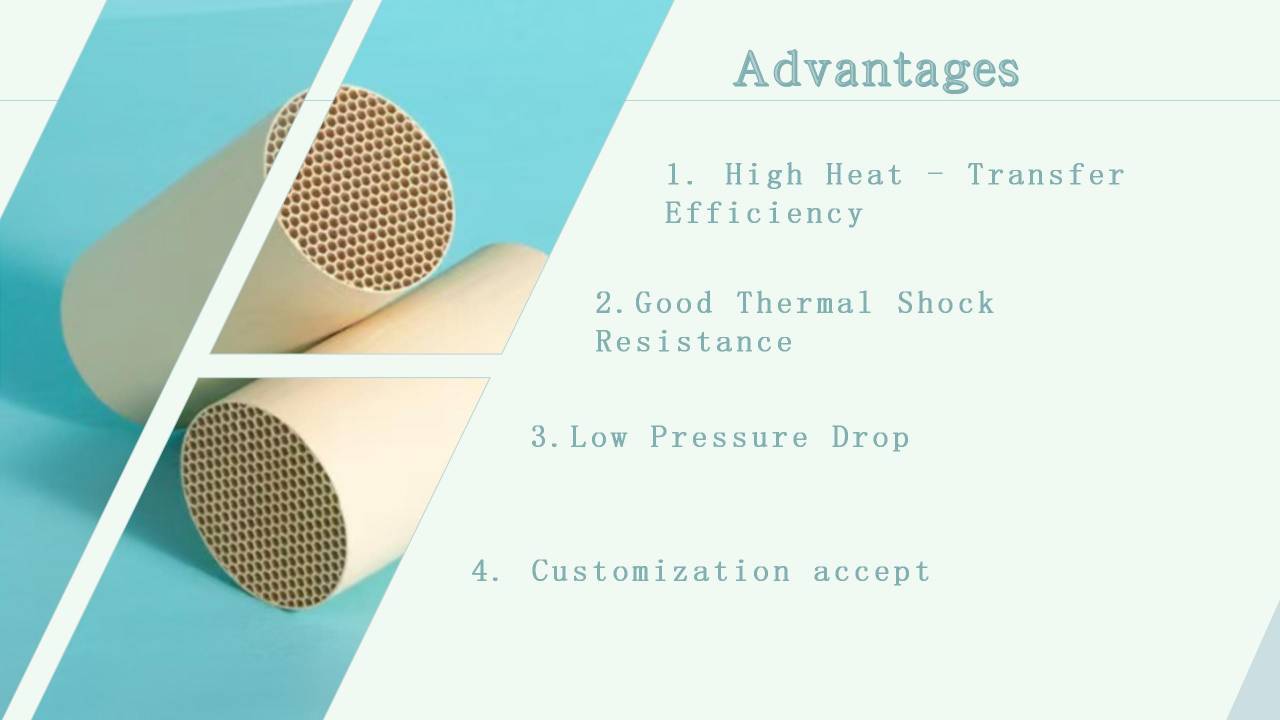
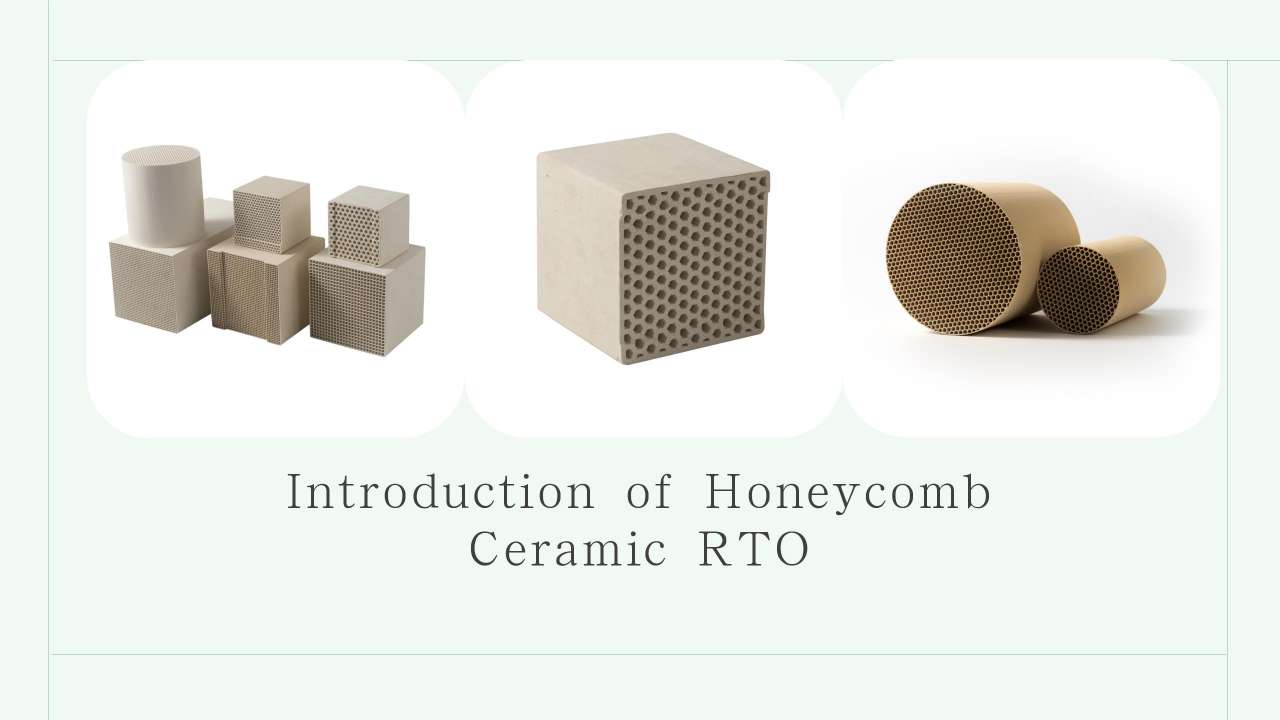
The heat storage properties of corundum-based regenerators and cordierite-based regenerators differ in terms of heat storage capacity, heat transfer efficiency, and heat exchange effectiveness in practical applications. Here is a detailed comparison:-Corundum-based Regenerator &Cordierite-based Regenerator
I. Comparison of Core Heat Storage Performance Indicators
| Performance Indicator | Corundum-based Regenerator | Cordierite-based Regenerator |
|---|---|---|
| Specific heat capacity (core indicator of heat storage capacity) | Relatively high, with a specific heat capacity of approximately 0.8-1.0 kJ/(kg·K) at room temperature. Mainly composed of α-alumina, its dense crystal structure allows it to store more heat per unit mass, resulting in stronger theoretical heat storage capacity. | Moderate, with a specific heat capacity of about 0.7-0.9 kJ/(kg·K) at room temperature, slightly lower than that of corundum-based ones. Cordierite, a silicate ceramic, has certain pores in its structure (or lower density due to added additives), leading to slightly weaker heat storage per unit mass. |
| Thermal conductivity (indicator of heat transfer efficiency) | High, with a thermal conductivity of around 20-30 W/(m·K) at room temperature. Heat transfers quickly inside the material, enabling rapid absorption of heat from high-temperature media and fast release of stored heat to low-temperature media, resulting in fast thermal response speed. | Low, with a thermal conductivity of approximately 1-3 W/(m·K) at room temperature. Heat transfer is slow, and the process of heat absorption and release is more gradual, leading to a relatively mild heat exchange rhythm. |
| Performance stability at working temperature | At high temperatures (e.g., above 1600°C), the attenuation of specific heat capacity and thermal conductivity is small, and the heat storage performance is stable, making it suitable for long-term heat storage in extreme high-temperature environments. | Stable at medium to low temperatures (1000-1200°C), but above 1300°C, it may decompose or soften, causing a decrease in specific heat capacity and weakened heat storage capacity. |
II. Differences in Heat Storage Effect in Practical Applications
- Corundum-based regenerators:
With high specific heat capacity and high thermal conductivity, they perform better in high-temperature scenarios (such as steelmaking furnaces above 1500°C and molten salt heat storage systems). For example, when high-temperature flue gas passes through, they can quickly absorb and store a large amount of heat; when heat release is needed, they can rapidly transfer heat to cold air or process media. They have large total heat storage per cycle and high heat exchange efficiency, suitable for high-temperature industrial scenarios requiring rapid “heat charging – heat discharging”. - Cordierite-based regenerators:
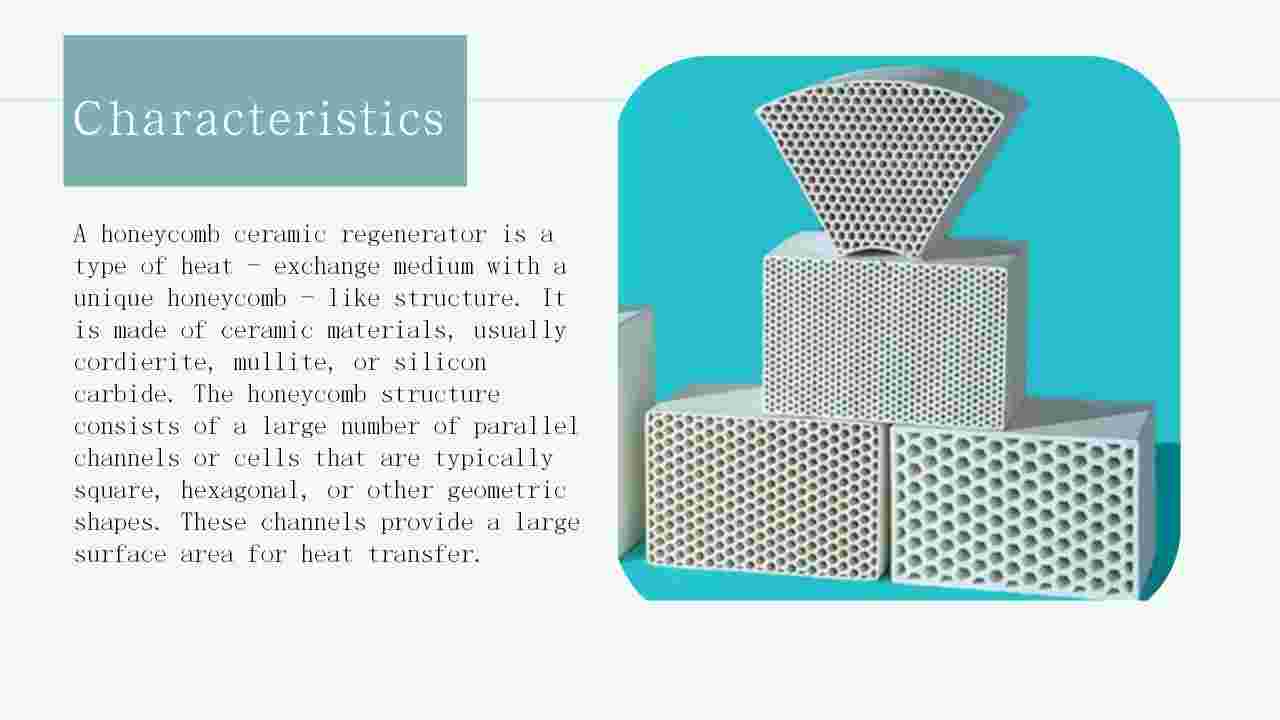
Although their specific heat capacity and thermal conductivity are slightly lower, their honeycomb structure provides a large specific surface area (e.g., common cordierite honeycomb regenerators can have a specific surface area of 800-1000 m²/m³), which can compensate for the slow heat transfer speed by increasing the contact area with the medium. In medium to low-temperature (800-1200°C) scenarios with frequent cold-heat cycles (such as waste heat recovery in gas-fired wall-hung boilers), their heat exchange efficiency per unit volume is not inferior. Moreover, due to good thermal stability, the attenuation of heat storage performance is slower during long-term use.
III. Summary: Core Differences in Heat Storage Performance
| Dimension | Corundum-based Regenerator | Cordierite-based Regenerator |
|---|---|---|
| Core advantages | Strong heat storage capacity per unit mass, fast heat transfer, and stable performance at high temperatures | Large specific surface area (compensating for slow heat transfer), stable long-term performance at medium temperatures |
| Applicable scenarios | High-temperature, industrial environments with large single heat exchange | Medium to low-temperature, small to medium heat exchange scenarios with frequent cycles |
In short, corundum-based regenerators are “high-temperature and high heat capacity type”, while cordierite-based ones are “medium-temperature and high-efficiency contact type”. Their heat storage performance advantages correspond to working environments with different temperatures and cycle frequencies.https://www.chempackings.com/honeycomb-ceramic/round-honeycomb-ceramic-heat-storage-body.html