
1. Specific Surface Area: Key to Heat Exchange Efficiency-RTO ceramic Regenerators
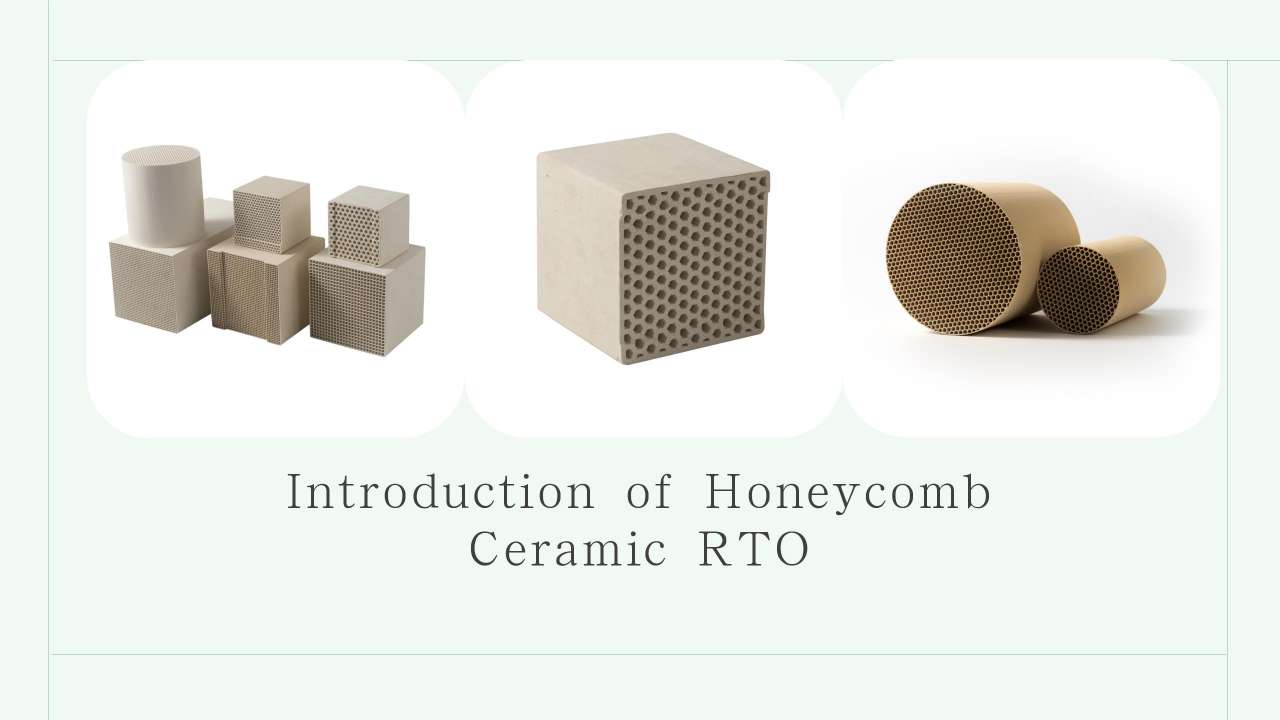
- Square Cells: The specific surface area (SSA) is determined by the perimeter-to-area ratio of the cell cross-section. For a square cell with side length a, the perimeter is 4a and the area is \(a^2\), giving an SSA of \(4/a\). In practical terms, a 5-mm square cell has an SSA of \(0.8 \, \text{mm}^{-1}\). However, the right-angle corners limit the packing density, reducing the effective surface area per unit volume to ~60–70% of the total volume.
- Hexagonal Cells: A regular hexagon with side length a has a perimeter of 6a and an area of \((3\sqrt{3}/2)a^2\), yielding an SSA of \(6a / [(3\sqrt{3}/2)a^2] = 4\sqrt{3}/(3a) \approx 2.31/a\). For a 5-mm hexagonal cell, the SSA is ~\(0.46 \, \text{mm}^{-1}\), which is ~15–20% higher than square cells. The close-packed honeycomb structure allows porosity up to 75–80%, maximizing the surface area available for heat transfer.
Impact: Hexagonal cells excel in high-intensity heat exchange systems (e.g., gas turbines) due to their larger SSA, while square cells are suitable for applications where moderate heat transfer suffices (e.g., industrial kilns).
2. Fluid Resistance: Effect on Pressure Drop-RTO ceramic Regenerators
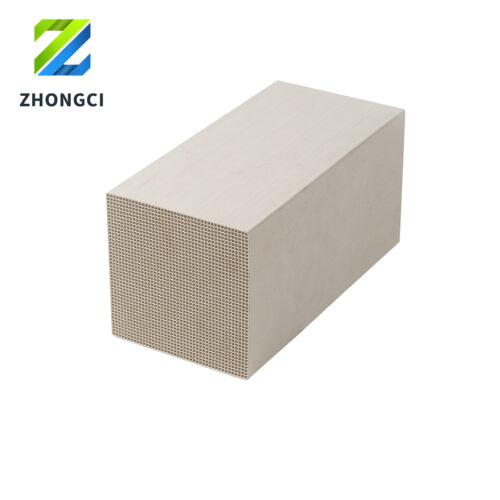
- Square Cells: The 90° corners create turbulent eddies as fluids pass through, increasing frictional resistance. For laminar flow, the pressure drop (\(\Delta P\)) in square channels follows the Darcy–Weisbach equation:\(\Delta P = f \cdot \frac{L}{D_h} \cdot \frac{\rho v^2}{2}\) where f is the friction factor (0.07–0.1 for square cells), L is the channel length, \(D_h\) is the hydraulic diameter (4a for square cells), \(\rho\) is fluid density, and v is velocity. In practice, square cells exhibit a pressure drop 1.2–1.5 times higher than hexagonal cells under the same flow conditions.
- Hexagonal Cells: The smooth 120° angles minimize eddy formation, reducing turbulence. The friction factor f for hexagonal channels is 0.05–0.08, leading to lower pressure loss. The hydraulic diameter of a hexagon with side length a is \(D_h = 2a\sqrt{3}/\pi \approx 1.09a\), which is slightly smaller than square cells, but the streamlined geometry dominates resistance reduction.
Impact: Hexagonal cells are preferred in systems requiring low energy consumption (e.g., automotive exhaust systems), while square cells are tolerated in applications where pressure drop is less critical (e.g., static regenerators).
3. Structural Strength and Thermal Shock Resistance
- Square Cells: Right-angle corners act as stress concentrators under thermal expansion or mechanical loads. For example, a temperature gradient of 300°C across the cell wall can induce tensile stresses of ~5–8 MPa at the corners, potentially causing micro-cracking. The modulus of rupture (MOR) for square-cell ceramics is typically 30–40 MPa, with a thermal shock resistance (R parameter) of ~150–200°C.
- Hexagonal Cells: The symmetric hexagonal structure distributes thermal stresses uniformly. The 120° angles reduce stress concentration, allowing MOR values of 40–50 MPa and a thermal shock resistance of ~250–300°C. For instance, hexagonal cells can withstand a 500°C temperature gradient without significant damage, making them suitable for rapid heating/cooling cycles.
Impact: Hexagonal cells are ideal for applications with frequent thermal fluctuations (e.g., regenerative burners), while square cells are better in stable temperature environments (e.g., fixed-bed reactors).
4. Heat Storage Efficiency and Thermal Conductivity
- Square Cells: The irregular heat flow paths (due to right angles) result in thermal conductivity (k) of ~1.5–2.0 W/m·K. The heat storage capacity (per unit volume) is ~1.2–1.5 kJ/m³·K, as the compact structure limits energy absorption.
- Hexagonal Cells: The uniform cell geometry promotes linear heat transfer, increasing k to 2.0–2.5 W/m·K. The higher porosity allows a heat storage capacity of ~1.8–2.2 kJ/m³·K, the result of both material properties and structural design. For example, in a molten salt storage system, hexagonal cells can store 10–15% more energy than square cells per unit volume.
Impact: Hexagonal cells are superior in energy storage systems (e.g., solar thermal plants), while square cells are adequate for low-intensity heat storage (e.g., small-scale furnaces).
5. Application-Specific Performance Trade-offs
| Performance Metric | Square Cells | Hexagonal Cells |
|---|---|---|
| Heat transfer coefficient | 20–30 W/m²·K (moderate) | 30–45 W/m²·K (high) |
| Flow uniformity | Poor (eddies at corners) | Excellent (streamlined flow) |
| Particle deposition | Higher (corners trap particulates) | Lower (smooth walls reduce fouling) |
| Cost-effectiveness | Lower production cost (simpler extrusion) | Higher cost (specialized molds required) |
| Optimal temperature range | <1200°C (due to stress limits) | <1400°C (superior thermal stability) |
6. Case Studies: Performance in Real-World Applications
- Industrial Boiler Regenerators: A 100-ton/h boiler using square-cell regenerators showed a heat recovery efficiency of 65–70%, with a pressure drop of 800–1000 Pa. Replacing them with hexagonal cells increased efficiency to 75–80% and reduced pressure drop to 500–600 Pa, saving ~15% in fuel consumption.
- Catalytic Converter for Heavy Trucks: Hexagonal-cell substrates (400 cells per square inch) achieved 92% NOx conversion at a space velocity of 50,000 h⁻¹, whereas square-cell substrates of the same size reached only 85% conversion due to poorer gas distribution.
7. Conclusion: Performance-Driven Design Guidelines
- Choose square cells if:
- Cost is a primary concern, and moderate heat transfer is acceptable.
- The application involves static or low-flow fluids with high particulate loads (e.g., cement kilns).
- Temperature fluctuations are minimal (<200°C).
- Choose hexagonal cells if:
- High heat exchange efficiency and low pressure drop are critical (e.g., energy recovery systems).
- The system experiences frequent thermal cycles or high-temperature extremes (>1000°C).
- Uniform fluid distribution and resistance to fouling are necessary (e.g., catalytic reactors).
RTO ceramic Regenerators
By balancing these performance parameters, engineers can optimize honeycomb ceramic regenerators for specific applications, ensuring maximum energy efficiency and durability.https://www.rtoceramic.com/product/honeycomb-ceramic-heat-exchanger/