
The performance advantages of alumina foam ceramics, as a porous ceramic material integrating structural and functional properties, are reflected in the following dimensions, making them irreplaceable in high-temperature, filtration, thermal insulation and other fields:
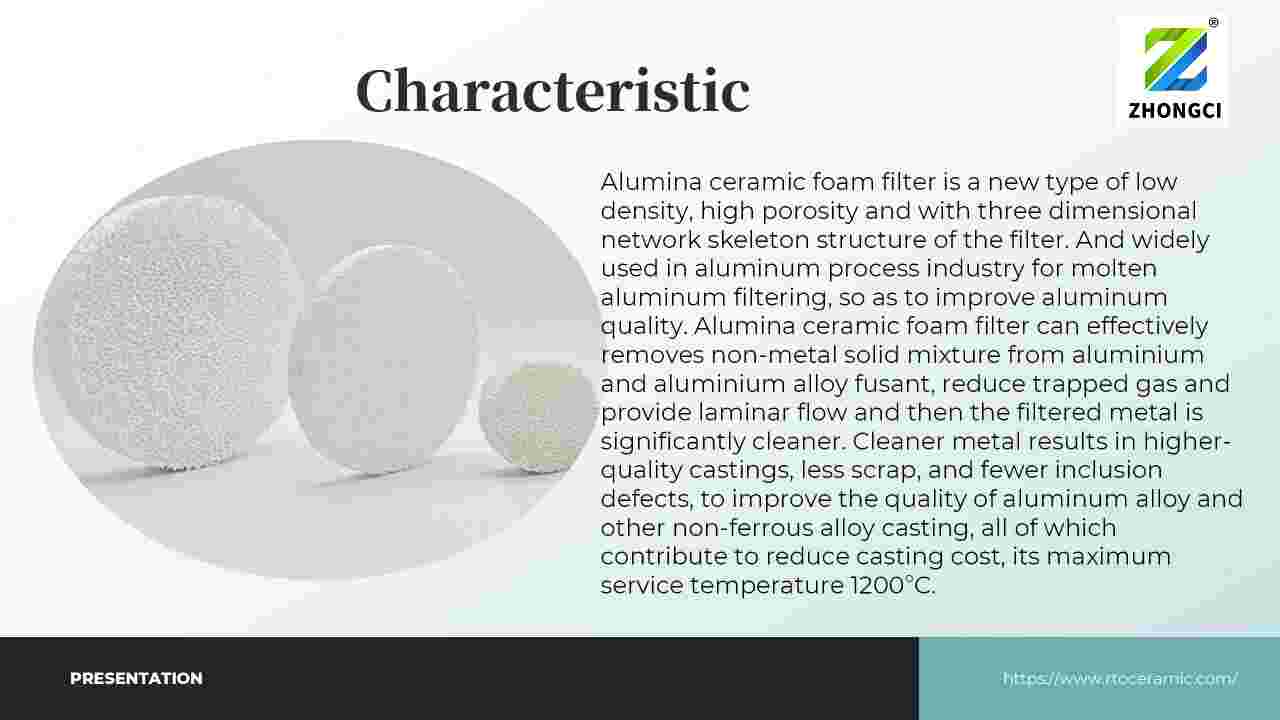
1. High Temperature Resistance and Thermal Stability
- High Melting Point and Thermal Shock Resistance
The main component alumina (Al₂O₃) has a melting point exceeding 2000°C. Foam ceramics can maintain structural integrity in high-temperature environments above 1800°C. The pore structure design relieves thermal stress and reduces the risk of cracking at high temperatures (e.g., used in furnace linings and high-temperature flue gas filtration). - Low Thermal Conductivity
The large number of air pores in the porous structure form a “thermal insulation barrier”, with thermal conductivity typically 0.1–0.5 W/(m·K), only 1/10–1/5 of dense alumina ceramics, effectively reducing heat transfer (e.g., thermal insulation layers for high-temperature equipment).
2. Mechanical Properties and Lightweight Advantage
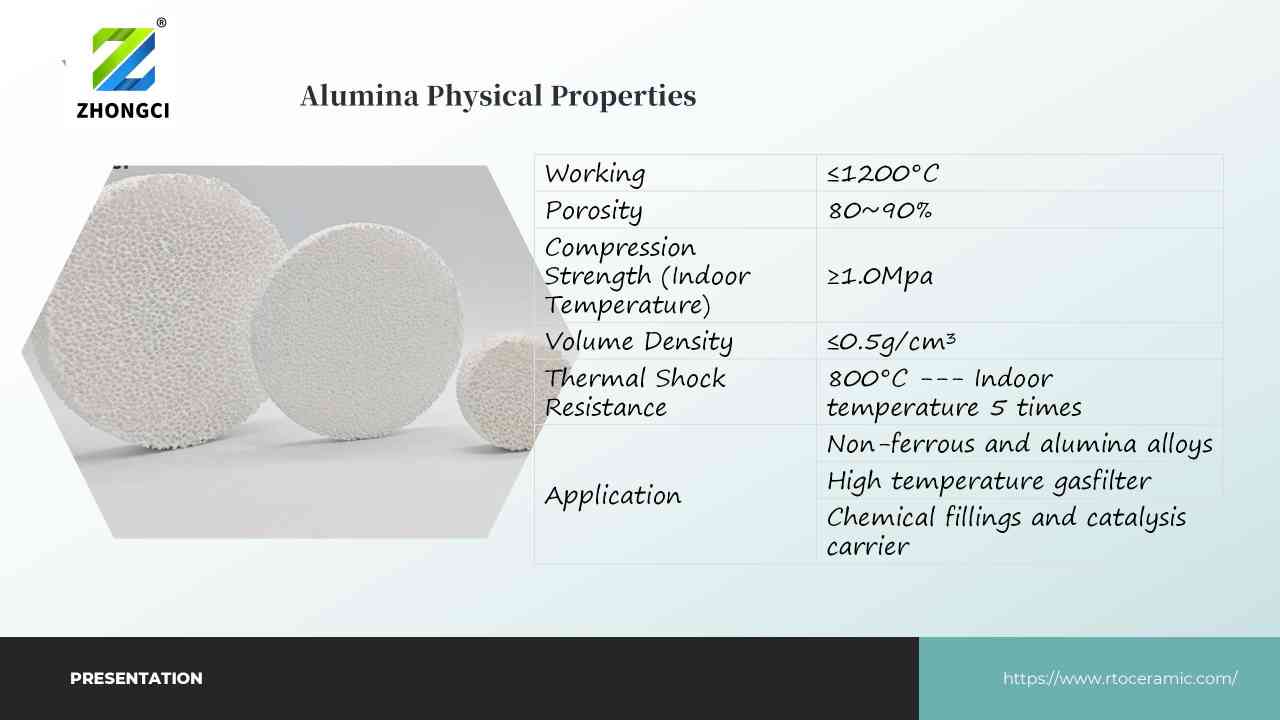
- Unity of Lightweight and High Strength
With a density of only 0.3–0.8 g/cm³ (about 1/3–1/5 of traditional ceramics), the compressive strength can reach 1–30 MPa (adjustable with porosity). For example, alumina foam ceramics with 80% porosity still have a compressive strength of 5–10 MPa, suitable for lightweight load-bearing scenarios (e.g., aerospace components and automotive lightweight structures). - Energy Absorption Characteristics
The porous structure can absorb energy through pore collapse under impact load, combining buffering and anti-deformation capabilities (e.g., protective materials).
3. Chemical Corrosion Resistance
- Excellent Chemical Inertness
Alumina has strong corrosion resistance to acid, alkali, salt solutions and molten metals (such as aluminum, iron, copper). For example, in aluminum liquid filtration, it does not chemically react with metals to avoid contamination (commonly used for impurity removal in the metallurgical industry). - Oxidation Resistance and Atmosphere Erosion Resistance
It is not easy to deteriorate in oxidizing atmospheres and high-temperature flue gases containing sulfur/carbon, and can be long-term used in industrial waste gas treatment equipment (e.g., desulfurization and denitrification catalyst carriers).
4. Functional Structural Advantages
- High Porosity and Connectivity
The porosity is 70%–95%, and more than 80% are connected pores, forming a three-dimensional interconnected network. This structure enables:- Efficient Filtration: Trapping solid particles in molten metal (e.g., removing inclusions in aluminum casting);
- Large Specific Surface Area: Serving as a catalyst support in environmental engineering (e.g., wastewater treatment, gas purification).
- Tailorable Pore Structure
Pore size (tens to hundreds of micrometers) and porosity can be adjusted via manufacturing processes to meet specific application requirements (e.g., fine filtration requires smaller pore sizes, while thermal insulation prefers higher porosity).
5. Thermal and Acoustic Insulation Integration
- Dual Insulation Performance
In addition to thermal insulation, the porous structure can also absorb sound waves, making it suitable for high-temperature noise reduction scenarios (e.g., exhaust systems of industrial furnaces).
6. Cost-Effectiveness and Process Adaptability
- Lower Production Costs
Compared with other high-performance ceramics (e.g., silicon carbide foam), alumina foam ceramics have more mature production processes (such as foaming method and template replication method), which are more cost-effective for large-scale applications. - Wide Process Compatibility
Compatible with post-processing such as coating and impregnation to enhance specific functions (e.g., coating with catalyst active components for catalytic applications).
These integrated advantages make alumina foam ceramics key materials in high-temperature engineering, metallurgical filtration, energy conservation, and environmental protection, continuously driving technological innovation in advanced manufacturing fields.https://www.chempackings.com/ceramic-foam-filter/