
Zirconia Foam Ceramic Filter: Structure, Properties and Applications
I. Material and Structural Characteristics
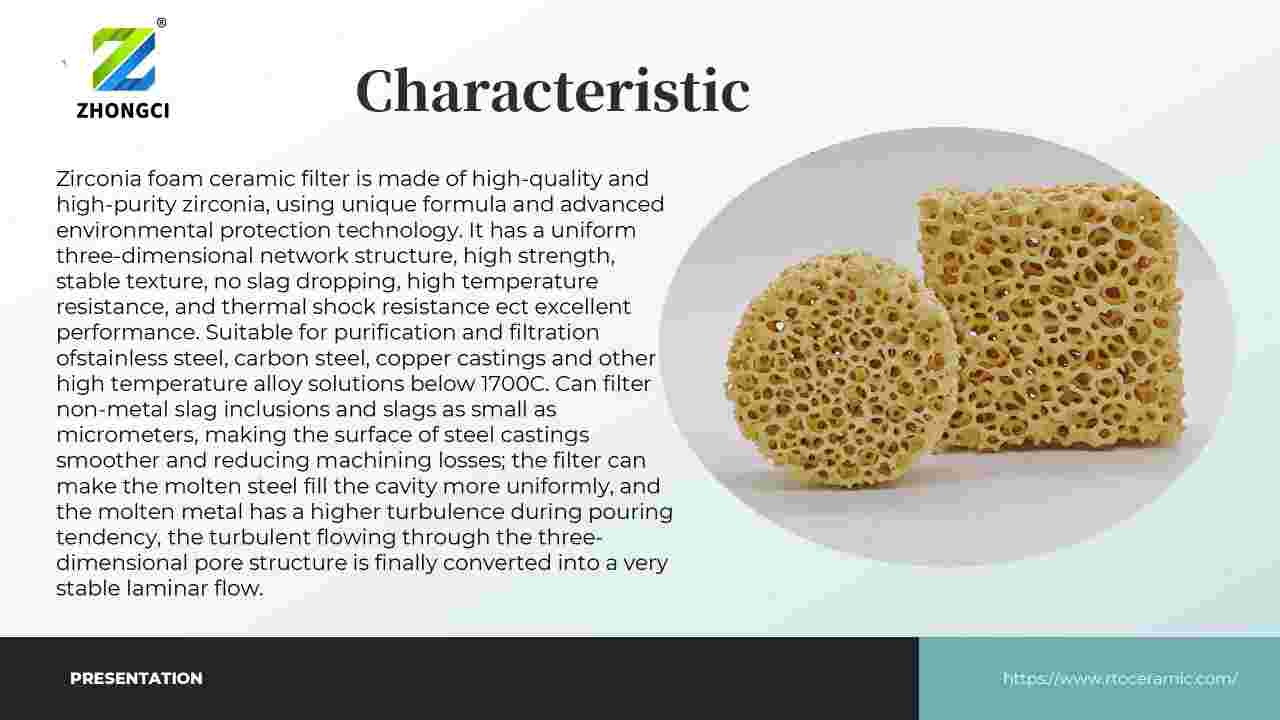
- Core Materials
- Mainly composed of zirconia (ZrO₂) with a purity of ≥99%, combining the high-temperature resistance and corrosion resistance of ceramics with the porous structure of foam materials.
- The phase transformation toughening property of zirconia gives it excellent thermal shock resistance (can withstand temperature differences of over 800°C).
- Microstructure
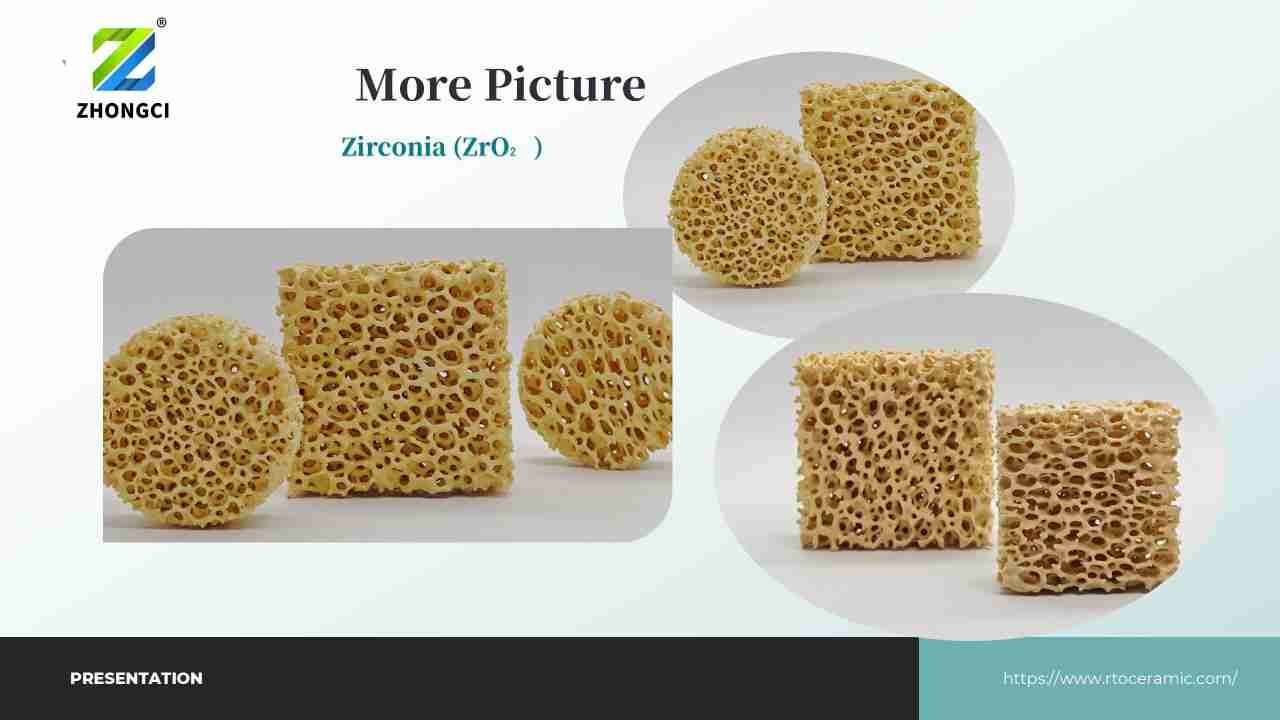
- Three-dimensional reticulated porous structure: Porosity ranges from 75% to 90%, with uniform pore size distribution (5–500μm adjustable) and large specific surface area (1–10 m²/g).
- Skeleton connectivity: Pores are interconnected to form a three-dimensional filtration network, ensuring low resistance and high filtration efficiency.
II. Key Performance Advantages
| Performance Dimension | Specific Performance | Application Value |
|---|---|---|
| High Temperature Resistance | Melting point up to 2700°C, long-term service temperature ≤2000°C, suitable for molten metals and high-temperature gases. | In steel casting, it can directly contact molten iron above 1600°C without softening or melting. |
| Corrosion Resistance | Resistant to acids, alkalis, and molten metals (e.g., iron, aluminum, copper alloys), with better chemical stability than alumina ceramics. | Used in chemical wastewater treatment, it resists strong acids and alkalis, extending service life. |
| Filtration Efficiency | Filtration efficiency for 5–10μm particles ≥95%, capable of 截留 (trapping) inclusions and slag in molten metals. | In aluminum alloy casting, it removes Al₂O₃ inclusions, increasing casting mechanical properties (strength up by 15%–20%). |
| Thermal Shock Resistance | No cracking or spalling after 1000°C water quenching cycle tests, suitable for 工况 (working conditions) with drastic temperature fluctuations. | For glass melt filtration, it withstands temperature changes during furnace start-up and shutdown. |
| Mechanical Strength | Compressive strength of 10–30 MPa, impact-resistant, not easy to break, suitable for high-flow or vibrating environments. | In metallurgical filtration equipment, it withstands metal liquid scouring and reduces debris contamination. |
III. Typical Application Scenarios
- Metallurgy and Casting
- Molten Metal Filtration: Removes oxide inclusions (e.g., FeO, Al₂O₃) during casting of cast iron, aluminum alloys, and copper alloys, improving casting surface finish and mechanical properties.
- Case Study: A car engine cylinder casting plant reduced casting defect rate from 8% to 1.5% after using zirconia foam ceramic filters.https://www.chempackings.com/ceramic-foam-filter/sic-ceramic-foam-filter-for-metal-filtration.html
- High-Temperature Gas Purification
- Industrial Furnace Tail Gas Treatment: Filters dust in high-temperature flue gas (e.g., power plant boilers, waste incinerators), 耐受 (withstanding) flue gas temperatures above 1200°C.
- Catalyst Support: The porous structure can load catalysts for high-temperature catalytic combustion of VOCs (volatile organic compounds).
- Environmental Protection and Energy
- Wastewater Treatment: Serves as a pretreatment layer for membrane filtration, removing suspended solids and colloids (e.g., heavy metal ion adsorption).
- Fuel Cells: Used as a support or gas distribution layer in solid oxide fuel cells (SOFCs) due to its high-temperature resistance and ion conductivity.
- Other High-End Fields
- Aerospace: Filters impurities in rocket fuel or acts as a high-temperature thermal insulation component.
- Semiconductor: High-purity zirconia filters purify electronic-grade gases (e.g., N₂, Ar) to prevent particle contamination.
IV. Comparison with Other Filter Materials
| Material Type | Zirconia Foam Ceramic | Alumina Foam Ceramic | Metal Wire Mesh Filter | Polymer Membrane Filter |
|---|---|---|---|---|
| Service Temperature | ≤2000°C | ≤1600°C | ≤800°C | ≤200°C |
| Corrosion Resistance | Excellent (resists molten metals, strong acids/alkalis) | Good (resists acids, not alkalis) | Medium (easily corroded by acids/alkalis) | Poor (degrades at high temperatures) |
| Filtration Precision | 5–10μm (adjustable) | 10–20μm | 20–50μm | 0.1–1μm (but poor temperature resistance) |
| Cost | High (expensive raw materials, complex sintering) | Medium | Medium | Low |
| Typical Applications | High-end casting, high-temperature flue gas purification | General metallurgy, chemical filtration | Normal-temperature liquid filtration | Water purification, food industry |
V. Preparation Processes and Technical Challenges
- Main Processes
- Organic Foam Impregnation Method: Coat zirconia slurry onto a polyurethane foam template, dry, and sinter at high temperature (1600–1800°C) to remove the template, forming porous ceramics.
- Foaming Method: Generate bubbles in the slurry by adding blowing agents (e.g., H₂O₂), followed by curing and sintering.
- Technical Challenges
- Pore Size Uniformity: Precise control of slurry viscosity and impregnation process is needed to avoid filtration efficiency fluctuations caused by pore size deviations.
- Sintering Densification: Zirconia’s phase transformation causes large volume changes, requiring optimized sintering schedules (e.g., stepwise heating) to prevent cracking.
VI. Market and Development Trends
- Growing Demand Areas: New energy vehicles (motor silicon steel sheet casting), photovoltaics (high-purity silicon material purification), hydrogen energy (fuel cell plate processing), etc.
- Technical Upgrades:
- Develop gradient pore structures (e.g., fine pores on the surface + coarse pores inside) to balance filtration precision and flow rate;
- Surface modification (e.g., coating catalyst layers) to expand integrated catalytic-filtration functions.
For specific product selection or process parameters, feel free to provide details of your application scenario for further analysis!https://www.rtoceramic.com/product/honeycomb-ceramic-heat-exchanger/