Widely Ranges of Foam Ceramic Functions

Table of Contents

1. Thermal insulation
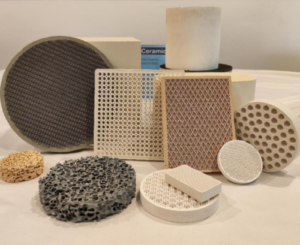
  • Foam ceramic sheets have a porous structure. These pores are filled with air. Air is a poor conductor of heat. As a result, the foam ceramic sheets can effectively reduce the transfer of heat. For example, in the construction industry, they can be used in the outer walls of buildings. By installing foam ceramic sheets, the indoor temperature can be better maintained, reducing the need for excessive use of heating in winter and air – conditioning in summer, thus saving energy and reducing costs.
  • Foam ceramic functions

2. Sound absorption and noise reduction

  • The porous nature of the foam ceramic sheets also enables them to absorb sound waves. When sound waves enter the pores, they are repeatedly reflected and scattered inside the pores. Some of the sound energy is converted into heat energy due to friction and other effects, thereby reducing the intensity of the sound. In industrial settings, such as factories or near highways, foam ceramic sheets can be used to build sound – insulating barriers to reduce noise pollution and create a relatively quiet environment for nearby residents and workers.

3. Filtration

  • The pores of the foam ceramic sheets can act as a filter medium. They can filter out particulate matter and impurities from gases or liquids. For instance, in the field of environmental protection, they can be used in the filtration of industrial waste gases. The complex pore structure can trap harmful particles such as dust, soot, and some heavy metal particles, purifying the gas before it is discharged into the atmosphere. In liquid filtration, they can be used to filter out solid impurities in solutions, playing an important role in water treatment and chemical process filtration.

4. Catalytic support

  • The high – surface – area – to – volume ratio of foam ceramic sheets makes them excellent carriers for catalysts. The large surface area provides more sites for the attachment of catalyst particles. When used in chemical reactions such as in the chemical industry or automotive exhaust treatment, the catalyst – loaded foam ceramic sheets can enhance the contact between the reactants and the catalyst, improving the efficiency of the catalytic reaction. For example, in automotive catalytic converters, the foam ceramic sheets can support precious – metal catalysts (such as platinum, palladium, and rhodium) to help convert harmful pollutants in exhaust gases (such as carbon monoxide, hydrocarbons, and nitrogen oxides) into less harmful substances.
  • Foam ceramic functions filter/https://www.chempackings.com/ceramic-foam-filter/

What is a honeycomb ceramic regenerator and what is its function?

Honeycomb ceramic regenerator is the key and core component of regenerative high-temperature combustion technology (HTAC technology). It has been widely used in various pusher-type heating furnaces, walking-type heating furnaces, heat treatment furnaces, forging furnaces, melting furnaces, ladle/tundish roasters, soaking furnaces, radiant tube burners, and hood-type furnaces in the metallurgical machinery industry. Furnace, blast furnace hot blast stove; various ceramic kilns, various glass kilns in the building materials industry; various tubular heating furnaces, cracking furnaces and other industrial furnaces in the petrochemical industry. Material of honeycomb ceramic regenerator: Regenerator material——mullite, cordierite, cordierite-mullite, corundum-mullite, high-aluminum and other materials honeycomb ceramic regenerator are resistant to With significant advantages such as high temperature, corrosion resistance, good thermal stability, high strength, large heat storage, and good thermal conductivity, the various indicators of the product can fully meet the use and operation requirements of industrial furnaces.

What is honeycomb ceramic regenerator – honeycomb ceramic regenerator hole pattern:

Thermal body hole type——Produces four hole types including square hole, hexagonal hole, round hole, and triangular hole.

Application of honeycomb ceramic regenerator: The principle of the regenerative incineration system (RTO) is to use ceramic regenerators to store the heat generated when organic waste gases are decomposed, and use the thermal energy stored in the ceramic regenerators to decompose untreated organic waste gases. , thereby achieving high thermal efficiency.

In view of the process requirements of the regenerative combustion deodorization oven (RTO), honeycomb ceramic products of various materials and sizes such as dense cordierite, loose cordierite, lithium porcelain, mullite, etc. are developed, which have large specific surface area and excellent exhaust resistance. Small, low thermal expansion and contraction coefficient, high bulk density, good thermal shock resistance and other characteristics.

This product is widely used in waste gas treatment equipment in the chemical industry, automotive paint, spray paint drying equipment, organic chemical industry, petrochemical industry, engraving printing, offset printing, food processing and other industries. For more specifications, please see the product page: Honeycomb Ceramic Regenerator

Share your Needs!

Share

Get Custom Quote

Have a question? Get in touch instantly using the form below.
Our customer support team would get back to you soon.

    Get Custom Quote