
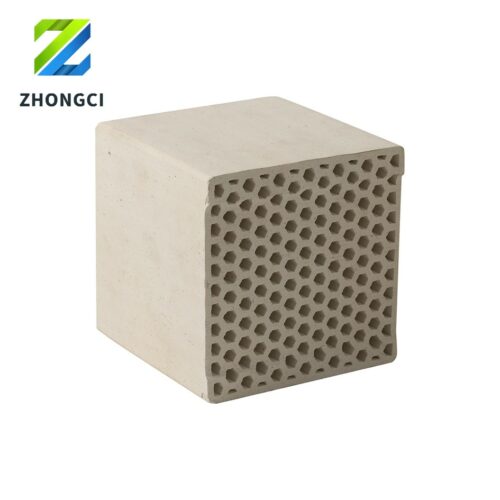
In industrial heating, honeycomb ceramic regenerators have several typical applications. The details are as follows:https://www.rtoceramic.com/product-category/all-products/rto-honeycomb-ceramic/
Metallurgical Industry
- Blast Furnaces: In the operation of blast furnaces, a large amount of high-temperature exhaust gas is generated. Honeycomb ceramic regenerators are used to recover the waste heat in the exhaust gas. The exhaust gas passes through the honeycomb channels, and the ceramic absorbs the heat. Then, the combustion air is preheated by passing through the regenerator, which can increase the temperature of the air entering the furnace. This helps to improve the combustion efficiency of the fuel in the blast furnace, reduce coke consumption, and increase the output and quality of iron.
- Steelmaking Furnaces: In electric arc furnaces and basic oxygen furnaces for steelmaking, honeycomb ceramic regenerators play a role in heat recovery and energy saving. They preheat the oxygen and fuel gases, making the combustion in the furnace more complete and efficient. This not only reduces energy consumption but also shortens the steelmaking cycle and improves production efficiency.
- Non-ferrous Metal Smelting: For the smelting of non-ferrous metals such as copper, aluminum, and zinc, honeycomb ceramic regenerators are used to recover waste heat from high-temperature flue gases. The recovered heat is used to preheat the air or process materials, which is of great significance for improving the thermal efficiency of the smelting process and reducing production costs.
Glass Industry
- Glass Melting Furnaces: Glass melting furnaces require a large amount of heat to melt glass raw materials. Honeycomb ceramic regenerators are installed in the furnace flue to recover the heat of the exhaust gas. The preheated air obtained by heat recovery is sent back to the furnace for combustion. and it can improve the temperature uniformity in the furnace, reduce energy consumption. And improve the quality of the glass melt. This is crucial for producing high-quality glass products with uniform thickness and optical properties.
- Glass Annealing Furnaces: In the glass annealing process, honeycomb ceramic regenerators can be used to control the temperature and heat transfer. They help to evenly release and absorb heat in the annealing furnace to ensure that the glass products cool down at a proper rate. And reducing internal stress and improving the mechanical strength and dimensional stability of the glass.
Ceramic Industry
- Ceramic Kilns: In the firing process of ceramic products, ceramic kilns need to maintain a certain high temperature. Honeycomb ceramic regenerators can recover the waste heat in the kiln exhaust gas and use it to preheat the air entering the kiln or the ceramic green body. This can not only save energy but also make the temperature distribution in the kiln more uniform. Which is beneficial to the firing of high-quality ceramic products and improving the pass rate of products.
- Ceramic Drying Equipment: Before the ceramic products are fired, they need to be dried. Honeycomb ceramic regenerators can be used in ceramic drying equipment to recover the heat of the exhaust gas from the dryer and use it to heat the drying medium (such as air). And improving the drying efficiency and reducing energy consumption.
Chemical Industry
- Chemical Reaction Furnaces: In some chemical reaction processes that require high temperatures, such as the synthesis of certain chemicals and the cracking of hydrocarbons. and they are used to recover waste heat and preheat reaction raw materials or combustion air. This can improve the reaction efficiency, reduce energy consumption. And increase the yield and quality of chemical products.
- Industrial Furnaces for Chemical Material Processing: For the processing of chemical materials such as calcination and roasting. Honeycomb ceramic regenerators can recover the heat of the exhaust gas from the furnace and use it to preheat the materials or combustion air. Which is of great significance for improving the thermal efficiency of the process and reducing production costs.
How does the structure of honeycomb ceramic regenerators contribute to their heat recovery efficiency?
Are there any limitations or challenges associated with the use of honeycomb ceramic regenerators in industrial heating?
Can they be used in other types of industrial processes besides heating?https://www.chempackings.com/honeycomb-ceramic/rto-heat-exchange-honeycomb-ceramic.html