
Silicon Carbide foam ceramics are a type of porous ceramic material characterized by their three-dimensional interconnected cellular structure. They combine the high-performance properties of SiC (e.g., thermal stability, chemical resistance, and mechanical strength) with a lightweight, sponge-like architecture. The foam structure typically features a porosity of 70–95%, with pore sizes ranging from a few micrometers to several millimeters, depending on the manufacturing process.https://www.rtoceramic.com/product/silicon-carbide-foam-ceramic-filter/
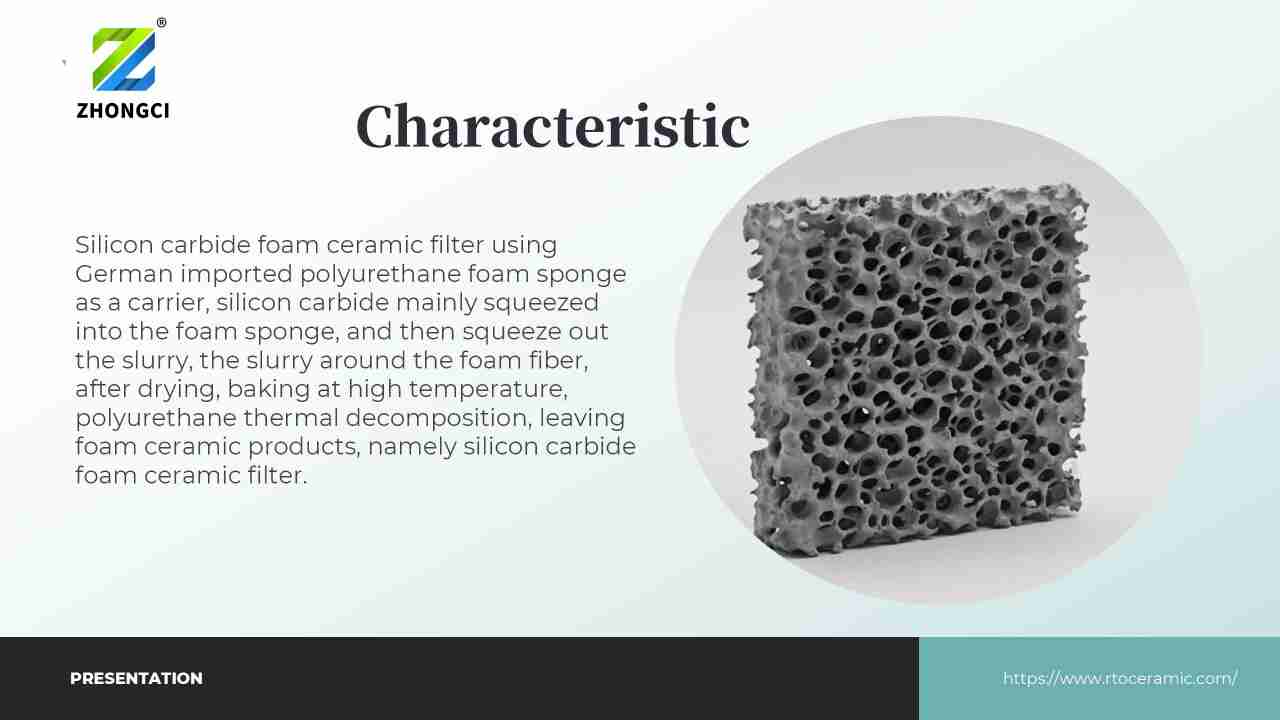
Key Properties
- High Thermal Conductivity: Enables efficient heat dissipation, making them suitable for high-temperature applications.
- Excellent Chemical Resistance: Resistant to corrosion from acids, alkalis, and harsh environments.
- Mechanical Strength: Maintains structural integrity at elevated temperatures (up to 1,600°C or higher).
- Lightweight: The porous structure reduces density while retaining durability.
- Thermal Shock Resistance: Withstands rapid temperature changes without cracking.
Manufacturing Processes
Common methods include:
- Template Replication (Foam Templating): Using polyurethane or polymeric foams as templates, coated with SiC slurry, then sintered to remove the template and form the ceramic skeleton.
- Direct Foaming: Introducing gas bubbles into a SiC suspension, followed by 固化 (curing) and sintering.
- Chemical Vapor Infiltration (CVI): Depositing SiC onto a preform structure in a high-temperature reactor.
Applications
- Energy and Environment:
- Catalyst supports in automotive exhaust systems for pollutant reduction.
- Filters for high-temperature gases in power plants and industrial furnaces.
- Heat Management:
- Heat exchangers in aerospace and electronic devices due to high thermal conductivity.
- Structural Components:
- Lightweight parts in aerospace and defense industries (e.g., thermal protection systems).
- Electronics:
- Substrates for high-power semiconductors to dissipate heat efficiently.

Advantages over Traditional Materials
- Compared to metal foams, SiC foam ceramics offer superior corrosion and high-temperature resistance.
- Compared to non-porous ceramics, their porosity enables unique functions like filtration and heat exchange.
Challenges and Developments
- Controlling pore uniformity and minimizing manufacturing costs remain key challenges.
- Ongoing research focuses on optimizing properties for emerging applications, such as energy storage and biomedical implants (with surface modification for biocompatibility).
In summary, SiC foam ceramics bridge the gap between high-performance ceramics and functional porous materials, driving innovation in industries demanding extreme environment resistance and efficient energy management.https://www.chempackings.com/ceramic-foam-filter/sic-ceramic-foam-filter-for-metal-filtration.html