
Preparation Process of Cordierite Honeycomb Ceramics
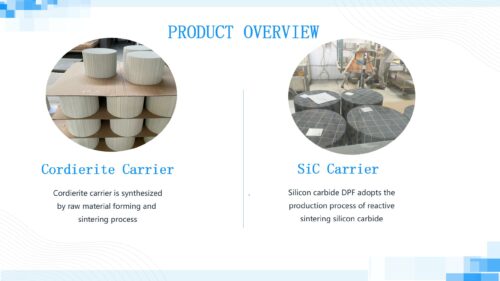
Synthesis Methods of Cordierite Honeycomb Ceramic Carrier
There are two main synthesis methods: solid-state synthesis and sol-gel synthesis.
(1) Solid-State Synthesis Method
Solid-state synthesis is the most widely used approach due to its simple process and high production efficiency, and it can be further divided into dry process and wet process (with the wet process being superior):
- Dry Process: Dry mixing of raw materials → semi-dry pressing into green bodies → drying → sintering.
- Wet Process: Raw materials are wet-milled with water in a ball mill → slurry dehydration via a filter press to form mud cakes → vacuum kneading → extrusion forming → drying → sintering.
(2) Sol-Gel Method (Liquid-Phase Method)
The sol-gel method is a wet chemical process using liquid reagents (or powdered reagents dissolved in solvents) or sols as raw materials. Reactants are uniformly mixed and reacted in the liquid phase to obtain the final product.
Applications of Cordierite Honeycomb Ceramics
Cordierite honeycomb ceramics have been successfully applied in multiple fields. with key applications in air pollution control, honeycomb ceramic regenerators, and sintering plates described below:https://www.chempackings.com/products
Air Pollution Control
With rapid economic development, environmental pollution from transportation (e.g., haze, PM2.5) has become increasingly severe. Cordierite honeycomb ceramics are widely used in pollution control . Due to their large specific surface area, excellent thermal stability, and low thermal expansion coefficient:
- Automotive exhaust treatment and removal of NOₓ/SO₃ from industrial flue gas.
- Fuji [13] summarized applications of honeycomb/foam ceramics in extreme environments (high temperature, strong corrosion) and highlighted that cordierite honeycomb ceramics, as catalyst supports, play a critical role in purifying vehicle emissions and reducing NOₓ from power plants.
4.2 Honeycomb Ceramic Regenerators Cordierite Honeycomb Ceramic Carrier
High Temperature Air Combustion (HTAC) is a revolutionary technology that preheats combustion air from room temperature to 800°C using high-efficiency regenerators, reduces NOₓ emissions, and recovers waste heat (flue gas temperature ≤ 150°C). The key to this technology is high-performance regenerator materials—cordierite honeycomb ceramics—featuring:
- High temperature resistance, corrosion resistance, thermal shock stability, high strength, large heat storage capacity, and good thermal conductivity, leading to significant energy savings and extended service life.
4.3 Sintering Plates
Cordierite honeycomb ceramics replace alumina plates as sintering plates in powder metallurgy and denture manufacturing due to their lightweight, fast heat conduction, and thermal stability:
- Denture sintering furnaces require rapid heating (from room temperature to 900°C in 2–3 minutes). Cordierite’s low thermal expansion coefficient ensures resistance to thermal shock during rapid heating.https://www.rtoceramic.com/products/