
honeycomb heat accumulator. four-effective-measures-to-slow-down-the-damage-of-honeycomb-heat-accumulator
Four Main Factors Affecting the Damage of the Heat storage accumulator
According to the main reasons for the damage of ceramic honeycomb in the use of regenerative heating furnace. The solution measures are put forward, hoping to provide help for the production. selection and wide application of honeycomb.
continuous in-depth study of regenerative heating furnace
Only the continuous in-depth study of regenerative heating furnace can give full play to the superiority of this technology.
Based on the analysis of the four main factors affecting the damage of the heat storage body. The actual use situation, the corresponding solutions are put forward.
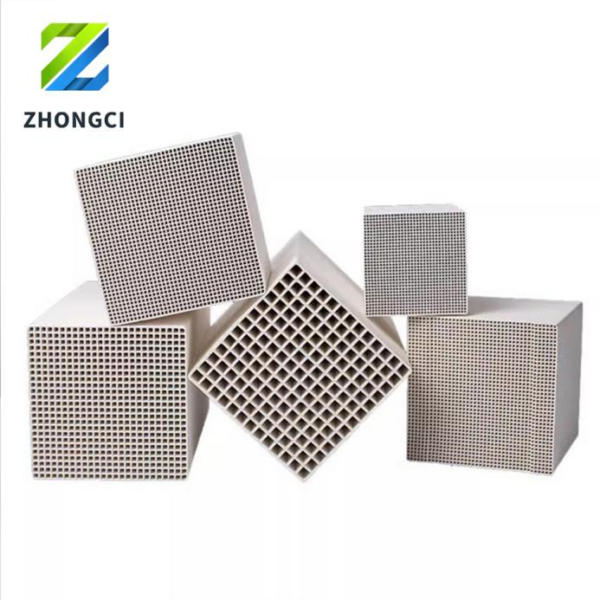
ceramic honeycomb material
01. ceramic honeycomb material
01
In the selection of ceramic honeycomb material, the aluminum content should not be blindly pursued. The higher the aluminum content, the higher the refractoriness, but the worse the thermal shock resistance. It is best to use two materials in the same heat storage room, and corundum, mullite and cordierite (or similar materials) are used successively from the inside direction to the outside direction of the furnace to achieve the best optimization of thermal shock resistance and refractoriness.
02. the actual production
02
In the actual production, the air-fuel ratio should be strictly controlled, the oxidation burning loss of billet should be reduced, the amount of ferrous oxide generated should be controlled, and then the ferrous oxide should be prevented from being sucked into the regenerative burner, causing damage to the honeycomb.
03. Incomplete combustion of ga
03
Incomplete combustion of gas will cause secondary combustion in the heat storage body, resulting in damage to the honeycomb. When designing the burner, the Angle, distance and momentum ratio of the two jets should be fully considered. At the same time, the air-fuel ratio is controlled to ensure the complete combustion of gas. In this way, there is no problem of secondary combustion in the honeycomb.
04. The choice of hole spacing and wall thickness of ceramic honeycomb
04
The choice of hole spacing and wall thickness of ceramic honeycomb body should be appropriate. The holes are of two forms. The first layer near the furnace adopts the large-hole and thick-wall structure, and the rest adopts the small-hole and thin-wall structure. It is not possible to choose too small hole structure in order to pursue greater than the surface, which affects the strength and is easy to block.
There is a partial gap between each layer of honeycomb (arc connection) to make the air flow smooth and avoid dust blockage. The appropriate commutation time is selected according to the hole distance and wall thickness. Through theoretical calculation, referring to the actual use of the heating furnaces in many steel mills, the small hole thin-wall heat accumulator mostly adopts the space of 2.8 ~ 3mm, the wall thickness of 0.8 ~ 1mm, and the commutation time of 30 ~ 60s. Longer reversing time is beneficial to the service life of key equipment such as reversing valves.