
The following are some factors that affect the performance of honeycomb ceramic carriers: purifier/https://www.rtoceramic.com/product-category/all-products/diesel-vehicle-dpf-honeycomb-ceramic-carrier-engineering-vehicle-black-smoke-catcher-dpf-particle-catcher-forklift-exhaust-purifier/
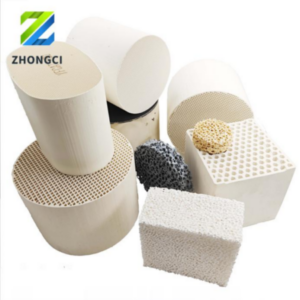
Material
- Ceramic type: Different ceramic materials have different physical and chemical properties. For example, cordierite ceramics have good thermal stability and a low coefficient of thermal expansion, enabling them to withstand the high temperature and thermal shock of automotive exhaust. Silicon carbide ceramics, on the other hand, have higher mechanical strength and thermal conductivity, suitable for applications with high requirements for strength and heat dissipation.
- Additives: Adding a small amount of fluxes, stabilizers and other additives to the ceramic matrix can improve the sintering performance, mechanical properties and chemical stability of the ceramics. For instance, adding rare earth elements can enhance the high-temperature stability and anti-aging performance of honeycomb ceramics.
Structural parameters
- Cell density: Cell density refers to the number of cells per unit area or volume. The higher the cell density, the larger the specific surface area, which is beneficial for the loading of catalysts and the adsorption of pollutants in the exhaust gas. However, it will also increase the gas flow resistance.
- Pore size distribution: A suitable pore size distribution enables the uniform diffusion of gas inside the honeycomb ceramics and improves the mass transfer efficiency. If the pore size is too large or too small, it will affect the interaction between the carrier and the catalyst as well as the treatment effect of the exhaust gas.
- Channel shape: Common channel shapes include circular, square and hexagonal. Hexagonal channels are widely used in honeycomb ceramic carriers due to their compact structure, large specific surface area and uniform gas flow distribution.
Preparation process
- Forming method: Different forming methods will affect the microstructure and performance of honeycomb ceramics. For example, the extrusion forming method can produce honeycomb ceramics with uniform pore size and regular channels. But for some carriers with complex shapes, methods such as injection molding or 3D printing may be required.
- Sintering process: Sintering process parameters such as sintering temperature and holding time have an important impact on the performance of honeycomb ceramics. An appropriate sintering process can make the ceramic particles fully densified, improving the mechanical strength and thermal stability of the carrier. However, an excessively high sintering temperature may lead to a decrease in pore size and specific surface area.
Service environment
- Temperature: Honeycomb ceramic carriers work in a high-temperature environment, and changes in temperature will affect their thermal stability and mechanical properties. Being in a high-temperature state for a long time may cause thermal fatigue, deformation or even cracking of the carrier.
- Chemical atmosphere: Automotive exhaust contains various harmful gases and impurities, such as sulfur dioxide and carbon particles. And which may react chemically with the honeycomb ceramic carriers and reduce the performance of the carriers.
- Mechanical vibration: Automobiles generate vibrations during driving. It puts forward high requirements for the mechanical strength of honeycomb ceramic carriers. If the mechanical strength of the carrier is insufficient. It may crack or be damaged under the action of vibration, affecting the exhaust gas treatment effect.https://www.chempackings.com/products