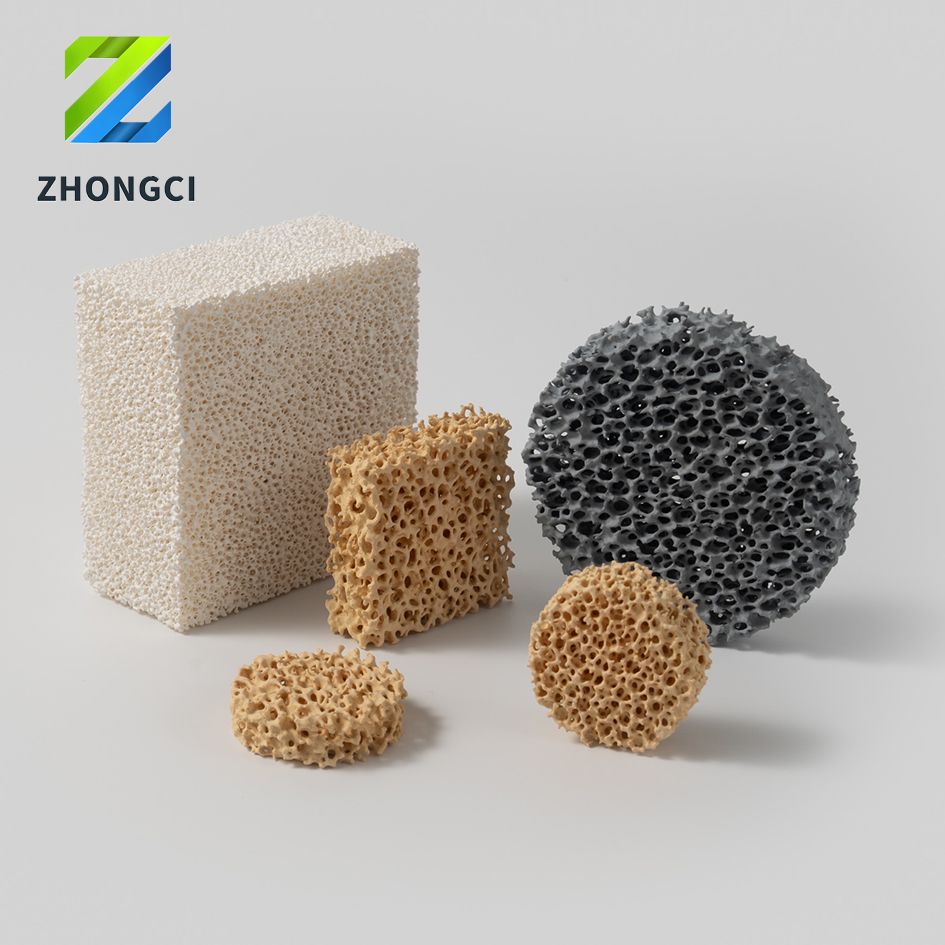
Traditional preparation method of foam ceramics:
1.1 Foaming method:
The foaming reaction method can be used to prepare foam ceramic products with complex shapes to meet the application of some special occasions; Adding appropriate ceramic fibers to the ceramic powder can improve this process. Effectively increase the strength of the green body during the sintering process, and avoid pulverization and collapse.
Regarding the Traditional preparation method of foam ceramics
1.2 Sol-gel method:
The sol-gel method is mainly used to prepare microporous ceramic materials with nanometer pore size. After improvement, this method can also prepare foam ceramic materials with high regularity. In the process of converting sol to gel, the viscosity of the system increases rapidly when preparing foam materials by sol-gel technology, thereby stabilizing the bubbles generated in the early stage and facilitating foaming. Compared with other processes, this process is unique. It can also prepare foam ceramic films with nanometer pore size and uniform pore distribution. It is now becoming the most active research field in the preparation process of inorganic films.
1.3 Adding pore-forming agent method:
By adding pore-forming agents to the ceramic ingredients, the pore-forming agents occupy a certain space in the green body. And then after sintering, the pore-forming agents leave the matrix to form pores to prepare foam ceramics.
The shape and size of the pore-forming agent particles determine the shape and size of the pores in the foam ceramic material. The main molding methods include molding, extrusion, isostatic pressing, rolling, injection and slurry casting. This method can be used to produce materials with complex shapes and different pore structures. But the uniformity of pore distribution is poor.
1.4 Organic precursor impregnation method:
The most ideal preparation method for foam ceramics is the organic precursor impregnation method, and its process flow is shown in the figure. Foam ceramics prepared by this molding method have been widely used in many fields and have achieved relatively obvious results. Further controlling the slurry properties, appropriately optimizing the inorganic binder system, and strictly controlling the slurry impregnation process can improve the performance of foam ceramic products.
Ceramic powder solvent, additives -> ; Slurry preparation Organic foam selection -> ; Pretreatment ==> ; Impregnation treatment -> ; Removal of excess slurry -> ; Drying -> ;
Elimination of organic foam -> ; Firing However, the organic precursor impregnation process has an obvious defect, that is, the pore structure of the product. especially the pore size,
depends on the pore structure and pore size of the selected organic foam. The mesh size of the selected organic foam is limited, which restricts the pore size and structure of the obtained foam ceramic material.
Zhu Xinwen et al. used three-dimensional mesh organic foam as a carrier, first prepared a mesh blank with high porosity and almost no pore blockage by impregnation process,
and obtained a preform with a certain strength after plastic removal and pre-sintering. The pores and struts of the preform are loose and porous, which solves this problem well.