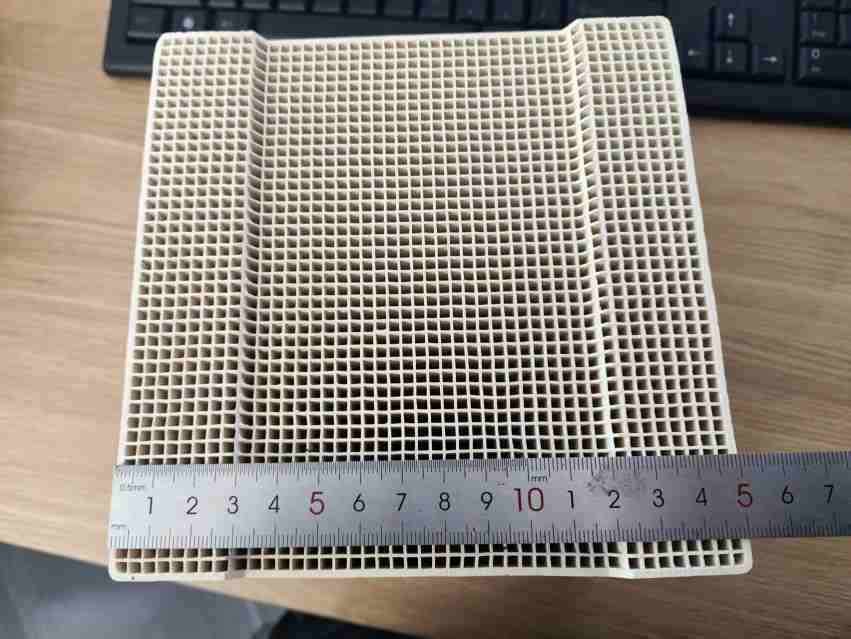
The 6-layer Zirconia corundum RTO design

Table of Contents

We recommend the upper layer to adopt a 4-layer structure with double grooves, featuring a pore size of 43×43mm and dimensions of 150×150×300mm. For the lower layer, we suggest a 2-layer structure—also with double grooves—made of zirconium corundum. It has a pore size of 25×25mm and dimensions of 150×150×150mm (this size delivers higher strength). All structures use a hexagonal hole design.​Zirconia corundum RTO also named RTO Ceramic, or honeycomb ceramic.
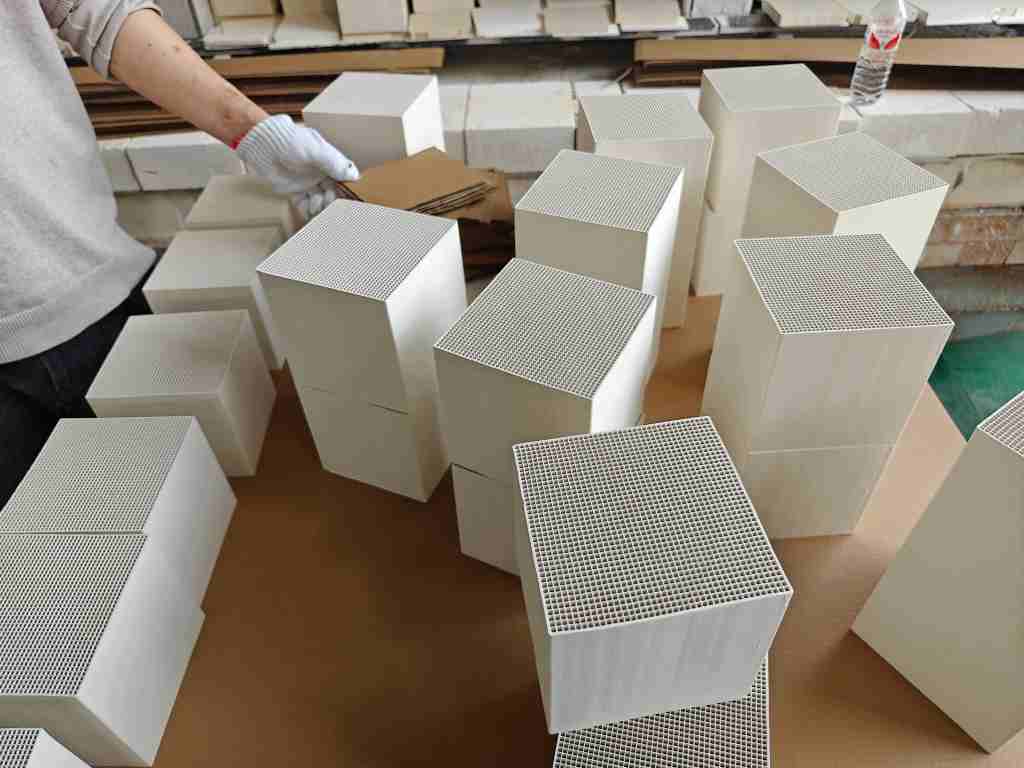
This is a typical “gradient pore structure + targeted materials” combination. Its core advantages focus on heat storage efficiency, heat exchange stability, corrosion resistance, and extended service life.​https://www.chempackings.com/honeycomb-ceramic/

Upper Layer: 4-layer Hexagonal Holes (43×43mm), Dimensions 150×150×300mm​-Zirconia corundum RTO

It boosts “high-efficiency heat storage + fine dust filtration” effects and improves energy utilization.​

As the “first contact layer” for airflow entering the heat storage body, it must prioritize two core functions: first, “rapid heat absorption” (it uses a large specific surface area for this), and second, “fine particle interception” (it relies on small pore size here). This reduces the load on the lower layer.​

Lower Layer: 2-layer Hexagonal Holes (25×25mm), Dimensions 150×150×150mm​

It ensures “smooth airflow + anti-clogging” and cuts down system energy consumption.​

After airflow passes through the upper layer—where the upper layer intercepts fine dust and conducts initial heat exchange—it enters the lower layer. The lower layer must meet two needs: first, “rapid passage” (to reduce resistance), and second, “deep heat release” (to match large pore size and achieve stable heat exchange). Additionally, it prevents coarse particle clogging: if coarse particles (that the upper layer fails to intercept) enter, the large pore size makes clogging hard to occur.​

  1. Zirconium Corundum Double Groove Design​

This design enhances “structural strength + airflow guidance” and suits high-temperature working conditions.​

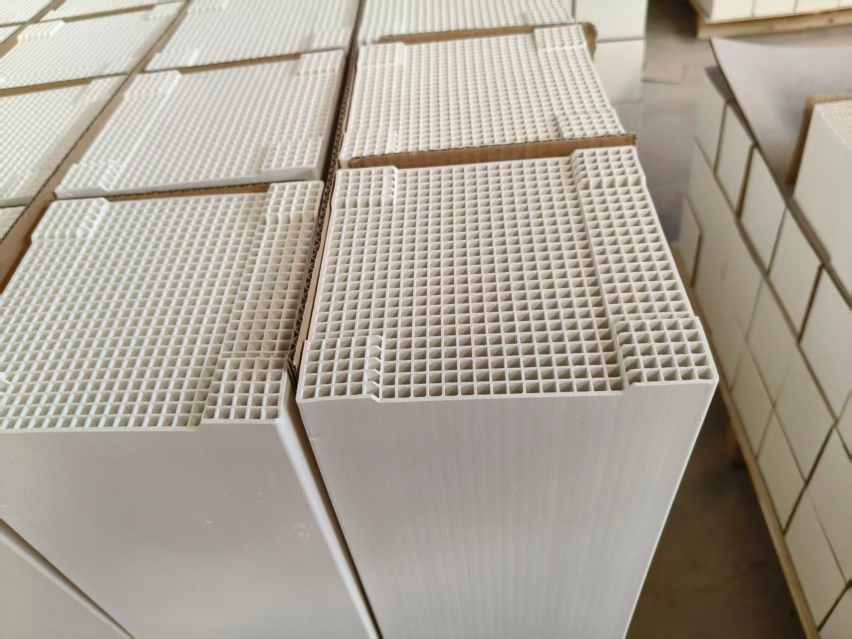
  • Higher Structural Strength: The double-groove design has cell walls 10%-15% thicker than those of conventional honeycomb cells. This reduces cracking—thin cell walls often cause cracking during high-temperature expansion (e.g., above 800°C). So it works especially well for the small-pore-size upper layer (where cell walls face more stress easily).​
  • Better Airflow Guidance: The double-groove design arranges its grooved channels in a “linear pattern”. When airflow passes through, it rarely generates “vortices”—ordinary honeycomb channels often form vortices at their corners, which leads to local heat accumulation. This further improves heat exchange uniformity and reduces impurity deposition in the channels.https://www.rtoceramic.com/products/
What is a honeycomb ceramic regenerator and what is its function?

Honeycomb ceramic regenerator is the key and core component of regenerative high-temperature combustion technology (HTAC technology). It has been widely used in various pusher-type heating furnaces, walking-type heating furnaces, heat treatment furnaces, forging furnaces, melting furnaces, ladle/tundish roasters, soaking furnaces, radiant tube burners, and hood-type furnaces in the metallurgical machinery industry. Furnace, blast furnace hot blast stove; various ceramic kilns, various glass kilns in the building materials industry; various tubular heating furnaces, cracking furnaces and other industrial furnaces in the petrochemical industry. Material of honeycomb ceramic regenerator: Regenerator material——mullite, cordierite, cordierite-mullite, corundum-mullite, high-aluminum and other materials honeycomb ceramic regenerator are resistant to With significant advantages such as high temperature, corrosion resistance, good thermal stability, high strength, large heat storage, and good thermal conductivity, the various indicators of the product can fully meet the use and operation requirements of industrial furnaces.

What is honeycomb ceramic regenerator – honeycomb ceramic regenerator hole pattern:

Thermal body hole type——Produces four hole types including square hole, hexagonal hole, round hole, and triangular hole.

Application of honeycomb ceramic regenerator: The principle of the regenerative incineration system (RTO) is to use ceramic regenerators to store the heat generated when organic waste gases are decomposed, and use the thermal energy stored in the ceramic regenerators to decompose untreated organic waste gases. , thereby achieving high thermal efficiency.

In view of the process requirements of the regenerative combustion deodorization oven (RTO), honeycomb ceramic products of various materials and sizes such as dense cordierite, loose cordierite, lithium porcelain, mullite, etc. are developed, which have large specific surface area and excellent exhaust resistance. Small, low thermal expansion and contraction coefficient, high bulk density, good thermal shock resistance and other characteristics.

This product is widely used in waste gas treatment equipment in the chemical industry, automotive paint, spray paint drying equipment, organic chemical industry, petrochemical industry, engraving printing, offset printing, food processing and other industries. For more specifications, please see the product page: Honeycomb Ceramic Regenerator

Share your Needs!

Share

Get Custom Quote

Have a question? Get in touch instantly using the form below.
Our customer support team would get back to you soon.

    Get Custom Quote