
Honeycomb ceramic regenerator are high-performance parts for storing and exchanging heat. They work in many industrial high-temperature processes. These processes include thermal oxidizers (RTO/RCO), metallurgical heating furnaces, glass kilns and waste incineration systems.
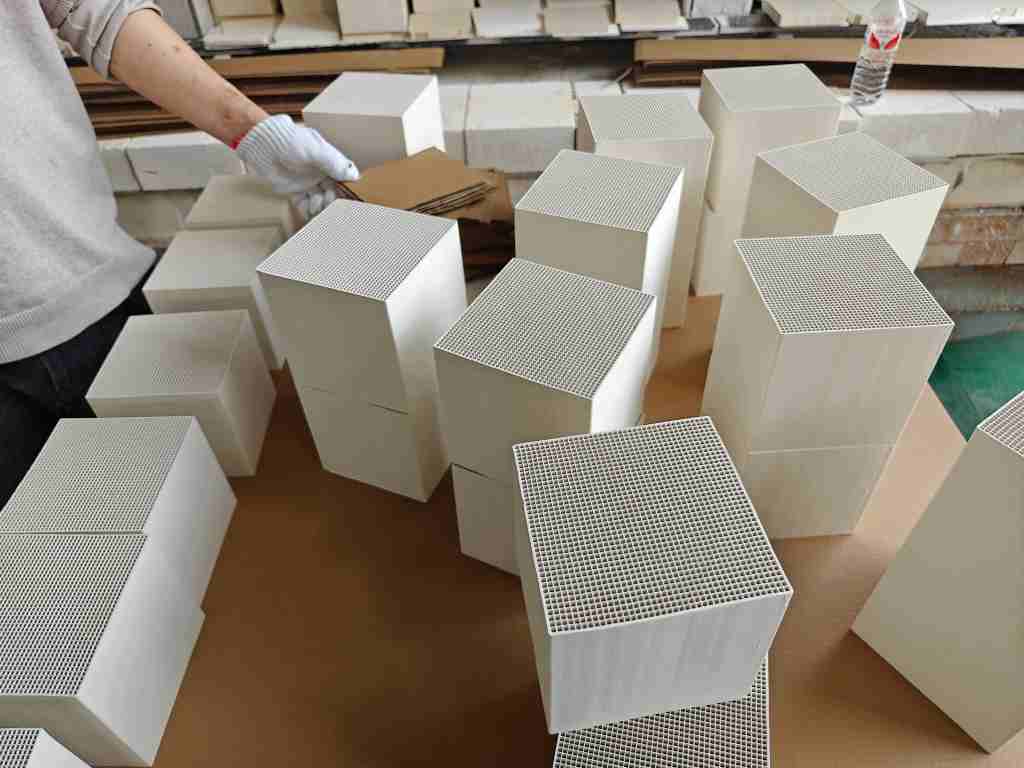
Their key strength comes from their honeycomb structure. This structure has dense, even channels. It boosts heat transfer efficiency, thermal storage capacity and resistance to thermal shock. So they fit perfectly in cyclic heat recovery scenarios.
1. Basic Materials and Their Traits
Honeycomb ceramic regenerator usually use high-purity ceramic materials. Common materials are cordierite, mullite, alumina and silicon carbide. These materials have great properties:https://www.chempackings.com/ceramic-foam-filter/sic-ceramic-foam-filter-for-metal-filtration.html
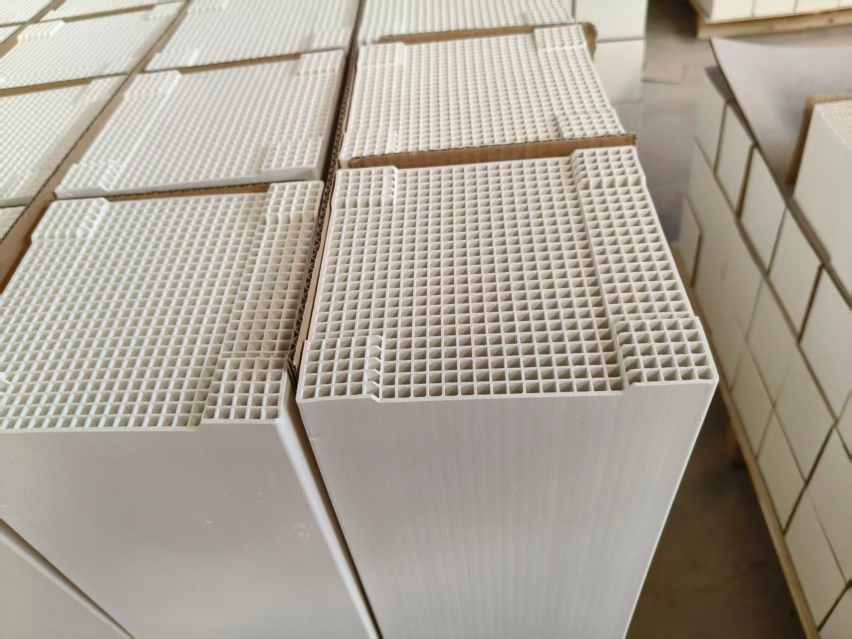
- They handle high temperatures well. They can work at 800–1,400°C (it depends on the material). They also resist cracking even when temperatures change fast (ΔT ≥ 500°C).
- They have low thermal expansion. For cordierite, the coefficient of thermal expansion (CTE) is as low as 1.5×10⁻⁶/°C. This stops them from deforming when heating or cooling.
- They are strong. Their compressive strength is over 15 MPa. This makes them durable against handling and vibrations in industrial processes.
2. Two Main Channel Types: Hexagonal vs. Square
The shape of the channels in the honeycomb structure affects three key things: heat transfer efficiency, pressure drop and resistance to particle buildup. Hexagonal and square cells are two common types. They suit different uses:
Hexagonal-Cell Regenerators
- They have even stress distribution. The hexagonal shape has no sharp corners. This cuts down localized thermal stress and makes them last longer.
- They have high packing density. They have more channels per unit area (like 200–400 cells per square inch, CPSI). This gives a larger heat transfer surface.
- They have low airflow resistance. Their smooth, curved channel walls reduce air turbulence and pressure loss.
- They work well in high-temperature, low-dust situations. These include RTO/RCO for VOC treatment and glass kiln heat recovery.
- Their cell size ranges from 1–5 mm (channel side length, equal to 100–600 CPSI).
Square-Cell Regenerators
- They are easy to make. The simple square mold design lowers production costs. This makes them good for large-batch manufacturing.
- They discharge particles well. Their right-angle corners reduce particle buildup. This is crucial for dusty processes like waste incineration.
- They have consistent channel cross-sections. This ensures even airflow and heat distribution across the whole regenerator.
- They fit medium-temperature, dusty processes. These include metallurgical forging furnaces, waste-to-energy plants and industrial boiler heat recovery.
- Their cell size ranges from 2–8 mm (channel side length, equal to 50–300 CPSI).
3. How They Work: Storing and Recovering Heat in Cycles
Honeycomb ceramic regenerators use a two-cycle mode to recover waste heat from high-temperature exhaust gases:
- Heat Storage Cycle: Hot exhaust gas (like 800–1,200°C from industrial furnaces) flows through the honeycomb channels. The ceramic material absorbs heat quickly. Its temperature rises to nearly the same as the exhaust gas.
- Heat Release Cycle: After a set time (usually 30–120 seconds), the airflow direction reverses. Cold fresh air (or process gas) passes through the preheated regenerator. It absorbs the stored heat and gets heated to 700–1,000°C. Then it goes into the furnace.
This cyclic process reaches 85–95% heat recovery efficiency. It cuts down fuel use and carbon emissions for industrial facilities a lot.
4. Key Benefits and Industrial Value
- They save energy. They replace traditional bulk ceramic balls or brick regenerators. They double heat transfer efficiency and cut energy use by 30–50% in high-temperature processes.
- They have a compact design. The honeycomb structure has a high surface area-to-volume ratio (up to 3,000 m²/m³). This lets the regenerator units be smaller and saves factory space.
- They last long. They resist corrosion from acidic or alkaline exhaust gases. They also stand up to thermal fatigue. They usually work for 3–5 years, even in harsh industrial environments.
In short, hexagonal and square-cell honeycomb ceramic regenerators are essential for modern industrial heat recovery. They balance efficiency, durability and adaptability to different process needs. Their flexible design (from cell shape to material choice) makes them a key part of energy-saving and low-carbon industrial practices.