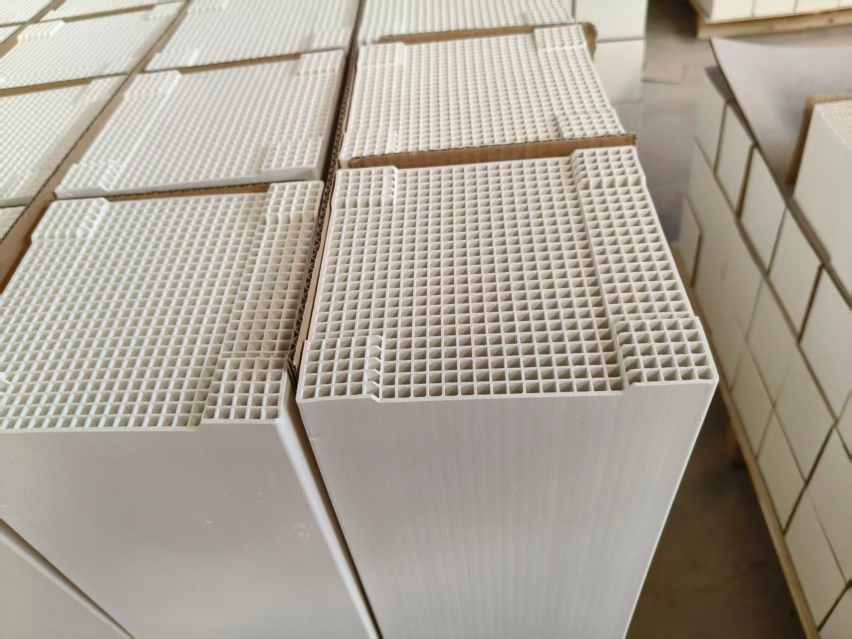
We recommend the upper layer to adopt a 4-layer structure with double grooves, featuring a pore size of 43×43mm and dimensions of 150×150×300mm. For the lower layer, we suggest a 2-layer structure—also with double grooves—made of zirconium corundum. It has a pore size of 25×25mm and dimensions of 150×150×150mm (this size delivers higher strength). All structures use a hexagonal hole design.Zirconia corundum RTO also named RTO Ceramic, or honeycomb ceramic.
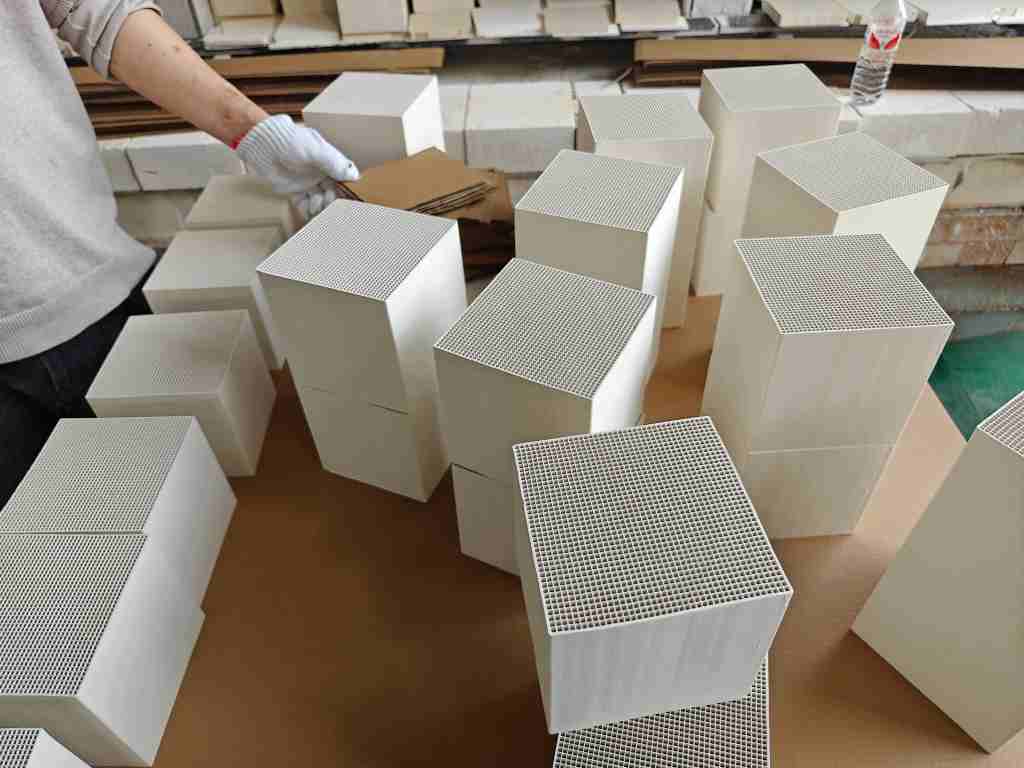
This is a typical “gradient pore structure + targeted materials” combination. Its core advantages focus on heat storage efficiency, heat exchange stability, corrosion resistance, and extended service life.https://www.chempackings.com/honeycomb-ceramic/
Upper Layer: 4-layer Hexagonal Holes (43×43mm), Dimensions 150×150×300mm-Zirconia corundum RTO
It boosts “high-efficiency heat storage + fine dust filtration” effects and improves energy utilization.
As the “first contact layer” for airflow entering the heat storage body, it must prioritize two core functions: first, “rapid heat absorption” (it uses a large specific surface area for this), and second, “fine particle interception” (it relies on small pore size here). This reduces the load on the lower layer.
Lower Layer: 2-layer Hexagonal Holes (25×25mm), Dimensions 150×150×150mm
It ensures “smooth airflow + anti-clogging” and cuts down system energy consumption.
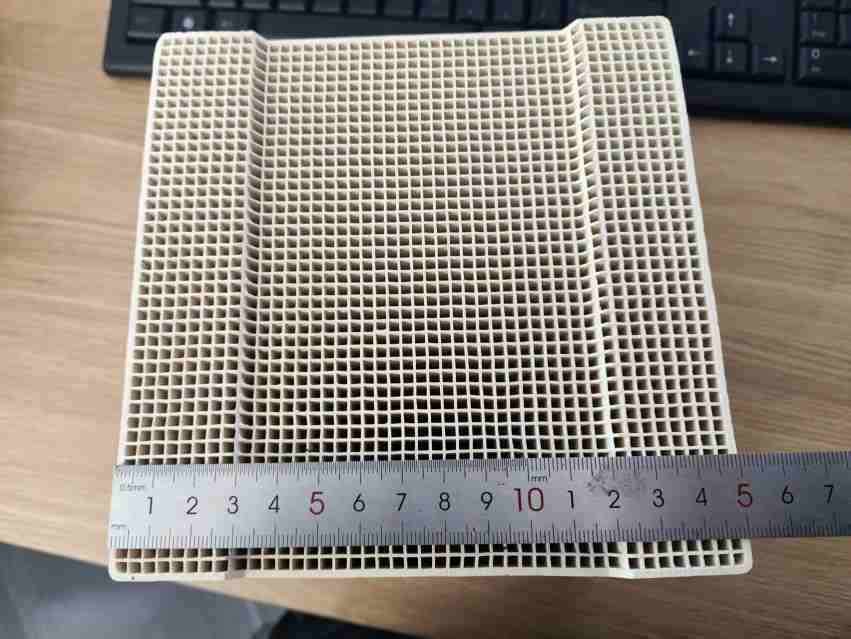
After airflow passes through the upper layer—where the upper layer intercepts fine dust and conducts initial heat exchange—it enters the lower layer. The lower layer must meet two needs: first, “rapid passage” (to reduce resistance), and second, “deep heat release” (to match large pore size and achieve stable heat exchange). Additionally, it prevents coarse particle clogging: if coarse particles (that the upper layer fails to intercept) enter, the large pore size makes clogging hard to occur.
- Zirconium Corundum Double Groove Design
This design enhances “structural strength + airflow guidance” and suits high-temperature working conditions.
- Higher Structural Strength: The double-groove design has cell walls 10%-15% thicker than those of conventional honeycomb cells. This reduces cracking—thin cell walls often cause cracking during high-temperature expansion (e.g., above 800°C). So it works especially well for the small-pore-size upper layer (where cell walls face more stress easily).
- Better Airflow Guidance: The double-groove design arranges its grooved channels in a “linear pattern”. When airflow passes through, it rarely generates “vortices”—ordinary honeycomb channels often form vortices at their corners, which leads to local heat accumulation. This further improves heat exchange uniformity and reduces impurity deposition in the channels.https://www.rtoceramic.com/products/